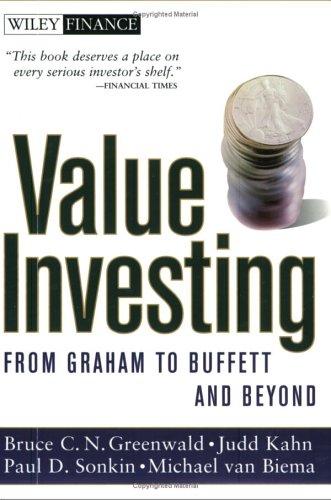
Talk to Value Investing: From Graham to Buffett and Beyond like its author wrote you back.
Get the ideas that fit your life — not generic summaries.
- Chat with the book
- Audiobook-style main ideas
- Adapts to your life and goals
- Helps you take action
Value Investing: From Graham to Buffett and Beyond, in detail
Value Investing: From Graham to Buffett and Beyond is Bruce Greenwald's attempt to update and extend the tradition that Benjamin Graham established. Greenwald, a Columbia Business School professor who taught in the same program that shaped Warren Buffett, argues that the essence of value investing is not simply buying cheap stocks — it is estimating what a business is worth independent of its market price, then buying only when the price offers a significant margin of safety.
The book is organized around three methods of valuation, each applied depending on the nature of the business. The first is asset value: what would it cost to reproduce the firm's assets? This is most relevant for capital-intensive businesses where asset reproduction cost is estimable. The second is earnings power value: what can the business earn in a normalized, sustainable year? The third, and most complex, is growth value: under what conditions does growth actually add value rather than merely increasing sales? Greenwald's key insight on growth is that it only creates value when a company earns returns above its cost of capital — a condition most businesses, most of the time, do not meet.
A substantial section covers franchise value and competitive advantage. Greenwald distinguishes between companies that earn above-average returns because of genuine moats — customer captivity, cost advantages, proprietary access — and those benefiting from temporary conditions. Only moat-protected businesses should trade at a growth premium; everything else should be valued on earnings power. The book profiles several well-known value investors, including Buffett, Walter Schloss, and Mario Gabelli, showing how each applies variants of the Graham framework.
The book is rigorous and academic in places. Readers who expect clear numerical worked examples throughout may find some sections more theoretical than they'd like. But for serious students of value investing, it is one of the better structured extensions of Graham's original work, particularly the treatment of competitive advantage as the precondition for crediting any growth in a valuation model.
The big ideas
- 1.
Intrinsic value is what a business is worth to a well-informed private buyer. The goal is to estimate that value, then buy at a significant discount to it.
- 2.
Asset value, earnings power value, and growth value are three distinct estimates that should be calculated separately and compared — not blended arbitrarily.
- 3.
Growth only adds value when a business earns returns above its cost of capital. For most businesses, growth is value-neutral or value-destructive.
