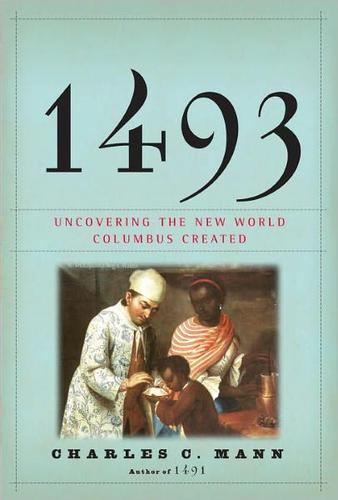
Talk to 1493: Uncovering the New World Columbus Created like its author wrote you back.
Get the ideas that fit your life — not generic summaries.
- Chat with the book
- Audiobook-style main ideas
- Adapts to your life and goals
- Helps you take action
1493: Uncovering the New World Columbus Created, in detail
Where 1491 ends, 1493 begins. After Columbus, Charles Mann argues, the world was fundamentally and permanently altered in ways that are still unfolding. The mechanism was what biologists call the Columbian Exchange: the movement of plants, animals, diseases, and people across the Atlantic and eventually around the entire globe. Mann's thesis is that this ecological event — unintentional, driven by market incentives, and accelerated by silver — was the origin of modern globalization and remains the largest ecological event in human history since the last ice age.
The book is organized around specific flows. Silver from the mines of Potosí and Mexico, extracted by coerced indigenous labor, funded the economies of Spain and China and underwrote the first genuinely global trade network. The Manila galleons created a direct link between the Americas and Asia that restructured Chinese agriculture and accelerated the decline of Ming dynasty. Rubber from Amazonia, potato from the Andes, and maize from Mesoamerica transformed agricultural systems, population dynamics, and political power across Europe, Asia, and Africa in ways their beneficiaries rarely acknowledged. Earthworms introduced from Europe disrupted North American forest ecology. The malaria and yellow fever that American mosquitoes spread after being transported on slave ships reshaped the demographics of the Caribbean and changed the military calculus of the American Revolution.
Mann's method is to follow specific substances, species, and people through the networks the exchange created. He travels to Potosí, to the river deltas of southern China where sweet potato farming changed peasant society, to the Caribbean plantation economies that the ecology of disease made possible and also eventually made untenable. The result is a deeply interconnected portrait of how a single navigational decision in 1492 set in motion chains of cause and effect that are still structuring the world we inhabit.
The book is longer and denser than 1491, and some sections reward patient reading more than others. But its core insight — that modern globalization is not a recent invention but a specific version of an exchange that began in 1493 — is genuinely illuminating. For anyone who wants to understand how the contemporary world economy and ecology were constructed, 1493 provides some of the most important backstory available in popular form.
The big ideas
- 1.
The Columbian Exchange — the transfer of plants, animals, diseases, and people following 1492 — was the largest ecological event since the last ice age and the true origin of modern globalization.
- 2.
Silver from the Americas funded the first genuinely global trade network and underwrote Spanish imperial power while restructuring the Chinese economy through the Manila galleon trade.
- 3.
American crops — potato, maize, cassava, sweet potato — transformed agricultural productivity and population growth across Europe, Africa, and Asia in ways that their adopters rarely attributed to the Americas.
