Talk to 1776 like its author wrote you back.
Get the ideas that fit your life — not generic summaries.
- Chat with the book
- Audiobook-style main ideas
- Adapts to your life and goals
- Helps you take action
1776, in detail
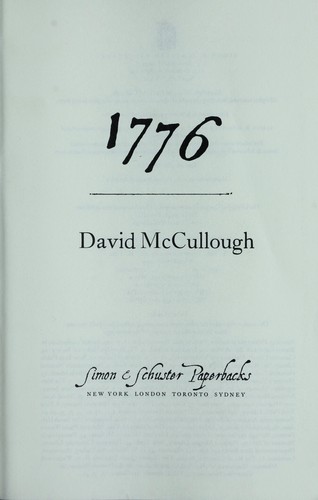
David McCullough's 1776, published in 2005, covers a single year of the American Revolution — from the winter siege of Boston through Washington's crossing of the Delaware and the surprise victory at Trenton. It is a deliberately narrow book: McCullough wants to show what the war actually looked like from the ground, not to provide a comprehensive account of the Revolution's political causes or its eventual resolution. The result is a fast-moving narrative of crisis management under conditions of near-constant failure.
The American army in 1776 was improvised, undertrained, and frequently unreliable. Enlistments ran out, men deserted, and officers proved inconsistent. Washington himself was an inexperienced commander who made serious tactical errors, particularly during the battles around New York in August and September, where the Continental Army came close to complete destruction. McCullough's portrait of Washington is notable for its candor about these failures — this is not hagiography but a study of how a leader responded when things went wrong.
The British perspective is given unusual weight. McCullough draws on the journals and letters of British officers and provides a detailed account of how General William Howe conducted the campaign. Howe's decision not to press his advantages — after the American retreat from Long Island, after the fall of Fort Washington — is presented as a strategic puzzle. McCullough suggests that Howe, a veteran of Bunker Hill's bloodbath, may have been reluctant to inflict the casualties necessary to finish the job.
The book ends at Trenton, where Washington's crossing of the ice-choked Delaware on Christmas night, followed by the capture of the Hessian garrison, restored enough confidence in the Continental Army's prospects to keep the rebellion alive through the winter. McCullough is explicit about the contingency: without that victory, the cause almost certainly would have collapsed within weeks. 1776 is shorter and less ambitious than his other major works, but it is among his most focused.
The big ideas
- 1.
The Continental Army in 1776 was an improvised force of undertrained volunteers whose enlistments were constantly expiring and whose reliability in combat was unpredictable.
- 2.
Washington made serious tactical errors in New York that nearly destroyed the army entirely. His greatest skill was not battle management but the ability to hold a deteriorating force together.
- 3.
The British had clear military superiority throughout the year and came close to ending the war in New York. Howe's failure to press those advantages remains a historical puzzle.
