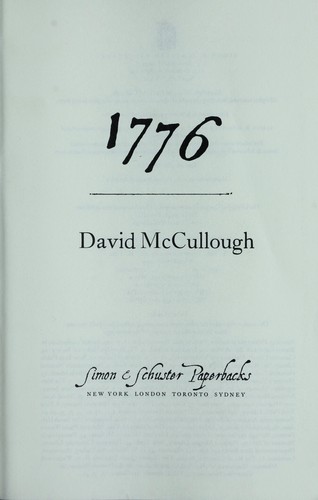
1776 by David McCullough is a 2005 history book about american revolution, military leadership, perseverance. The Continental Army in 1776 was an improvised force of undertrained volunteers whose enlistments were constantly expiring and whose reliability in combat was unpredictable.
Summary
David McCullough's 1776, published in 2005, covers a single year of the American Revolution — from the winter siege of Boston through Washington's crossing of the Delaware and the surprise victory at Trenton. It is a deliberately narrow book: McCullough wants to show what the war actually looked like from the ground, not to provide a comprehensive account of the Revolution's political causes or its eventual resolution. The result is a fast-moving narrative of crisis management under conditions of near-constant failure.
The American army in 1776 was improvised, undertrained, and frequently unreliable. Enlistments ran out, men deserted, and officers proved inconsistent. Washington himself was an inexperienced commander who made serious tactical errors, particularly during the battles around New York in August and September, where the Continental Army came close to complete destruction. McCullough's portrait of Washington is notable for its candor about these failures — this is not hagiography but a study of how a leader responded when things went wrong.
The British perspective is given unusual weight. McCullough draws on the journals and letters of British officers and provides a detailed account of how General William Howe conducted the campaign. Howe's decision not to press his advantages — after the American retreat from Long Island, after the fall of Fort Washington — is presented as a strategic puzzle. McCullough suggests that Howe, a veteran of Bunker Hill's bloodbath, may have been reluctant to inflict the casualties necessary to finish the job.
The book ends at Trenton, where Washington's crossing of the ice-choked Delaware on Christmas night, followed by the capture of the Hessian garrison, restored enough confidence in the Continental Army's prospects to keep the rebellion alive through the winter. McCullough is explicit about the contingency: without that victory, the cause almost certainly would have collapsed within weeks. 1776 is shorter and less ambitious than his other major works, but it is among his most focused.
Talk to 1776 like its author wrote you back.
Get the ideas that fit your life — not generic summaries.
- Chat with the book
- Audiobook-style main ideas
- Adapts to your life and goals
- Helps you take action
Key takeaways
- 1.
The Continental Army in 1776 was an improvised force of undertrained volunteers whose enlistments were constantly expiring and whose reliability in combat was unpredictable.
- 2.
Washington made serious tactical errors in New York that nearly destroyed the army entirely. His greatest skill was not battle management but the ability to hold a deteriorating force together.
- 3.
The British had clear military superiority throughout the year and came close to ending the war in New York. Howe's failure to press those advantages remains a historical puzzle.
- 4.
The retreat from New York and across New Jersey was a logistical and psychological near-collapse that required constant improvisation to prevent total disintegration.
- 5.
The crossing of the Delaware on December 25-26 and the capture of the Hessians at Trenton was a calculated gamble by Washington. Victory was essential to prevent the army from dissolving when enlistments ran out at year's end.
- 6.
American soldiers were not uniformly heroic or committed. Desertion was common, morale was low, and the conditions — cold, illness, inadequate supply — were genuinely terrible.
- 7.
The political pressure on Washington was continuous. Congress micromanaged, local commanders disagreed, and the civilian population in many areas was indifferent or actively Loyalist.
- 8.
The year 1776 illustrates that the Revolution's success required British mistakes as much as American persistence. It was not won so much as survived.
Discussion questions
Use these on your own, with a book club, or as chat starters in Superbook. Book club version, ready to copy or print →
- 1.
McCullough focuses on a single year rather than the full Revolution. What does that narrow focus reveal that a broader account would miss?
- 2.
Washington made serious errors in New York. How do you evaluate a leader whose success comes less from tactical brilliance than from the ability to recover from mistakes?
- 3.
Howe had multiple opportunities to end the war and didn't take them. What does McCullough suggest about his reasons, and does that explanation satisfy you?
- 4.
The Continental Army was constantly on the edge of dissolution. What kept it together when material conditions and military results were so discouraging?
- 5.
McCullough gives significant attention to ordinary soldiers through their letters and journals. What do those accounts reveal that the strategic narrative alone cannot?
- 6.
The crossing of the Delaware is one of the most famous moments in American history. Does reading the actual account in detail change how you understand it?
- 7.
The book suggests that much of the surrounding population was indifferent or Loyalist. How does that complicate the popular narrative of a united patriot cause?
- 8.
British officers wrote letters and journals that McCullough quotes extensively. What does their perspective add to the account?
- 9.
1776 is a much shorter book than McCullough's John Adams or Truman. Does the compression serve the subject, or do you feel something important is missing?
- 10.
The survival of the Continental Army through 1776 required luck as well as perseverance. How do you weigh contingency and character in explaining the Revolution's eventual success?
- 11.
What does this account of the Revolution's military reality suggest about how we commemorate it today?
- 12.
If the crossing of the Delaware had failed or the attack at Trenton had been repulsed, how close was the war to ending in British victory?
Themes
Frequently asked questions
-
Is 1776 worth reading if I've already read John Adams?
Yes. The books cover different ground. John Adams is a biography spanning decades; 1776 is a tight narrative of a single military year, with more attention to Washington, ordinary soldiers, and the British perspective. The focus is different enough that they complement rather than overlap.
-
How long does it take to read 1776 by McCullough?
About 290 pages — roughly 7-9 hours at average pace. It is one of McCullough's shorter books and reads quickly. Most readers finish it in a weekend or a few evenings.
-
Is 1776 historically accurate?
McCullough is careful about sourcing and draws on primary documents throughout. Some historians note that he gives Washington slightly too much credit for events that also depended on British mistakes and weather. Overall it is a reliable narrative account.
-
Does 1776 cover the whole Revolutionary War?
No. It covers only the year 1776, from the siege of Boston through the battle of Trenton. It ends on an upswing but the war continued for seven more years. Readers who want the full arc need additional books.
-
Who should read 1776?
Readers who want to understand what the Revolutionary War actually felt like from the ground — not the ideology or the political founding but the physical reality of the military campaign. It is a good introduction to the period for readers who find longer Revolutionary histories daunting.