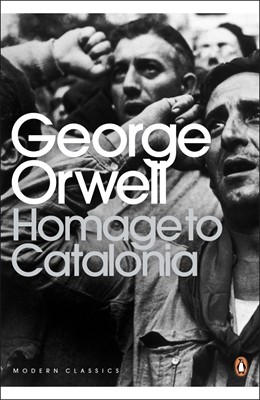
Talk to Homage to Catalonia like its author wrote you back.
Get the ideas that fit your life — not generic summaries.
- Chat with the book
- Audiobook-style main ideas
- Adapts to your life and goals
- Helps you take action
What it argues
Homage to Catalonia is George Orwell's firsthand account of fighting in the Spanish Civil War, which he joined in late 1936 as a volunteer with the POUM militia — a Trotskyist revolutionary organization that was later suppressed by the Soviet-backed Stalinist wing of the Republican forces. Orwell arrived in Barcelona expecting a socialist revolution in progress and found something genuinely remarkable: a city where the working class appeared to run its own affairs, class distinctions had temporarily dissolved, and revolutionary egalitarianism was not propaganda but an observable social fact.
The memoir traces Orwell's experience from the training camps to the Aragón trenches — a war of stasis, boredom, and frostbite punctuated by occasional skirmishes — through his near-fatal wounding by a fascist sniper, and then to the May Days of 1937, when Communist-aligned forces attacked the POUM and its anarchist allies in Barcelona. The street fighting in the city that nominally formed a unified front against Franco shocked Orwell profoundly. He had come to fight fascism and found himself ducking Communist assassins on the Republican side.
What it gets right
- 1.
Revolutionary politics in practice are messier and more faction-ridden than ideology suggests; Orwell found as much danger from Communist purges as from fascist bullets.
- 2.
The suppression of the POUM by Soviet-backed Communists in 1937 is an early documented case of how authoritarian politics can subvert a movement from within while directing propaganda outward.
- 3.
The experience of watching events he witnessed firsthand reported falsely in the press radicalized Orwell's understanding of how political language works — and how it can be weaponized.
What it covers
Who wrote it
George Orwell was the pen name of Eric Arthur Blair (1903–1950), an English novelist, essayist, and critic. Born in India and educated at Eton, he worked as a colonial policeman in Burma before turning to writing. His major works include Down and Out in Paris and London, The Road to Wigan Pier, Animal Farm, and Nineteen Eighty-Four. Orwell's nonfiction and essays are collected in several volumes and remain among the most widely read political prose in the English language. He died of tuberculosis in 1950 at the age of 46.
