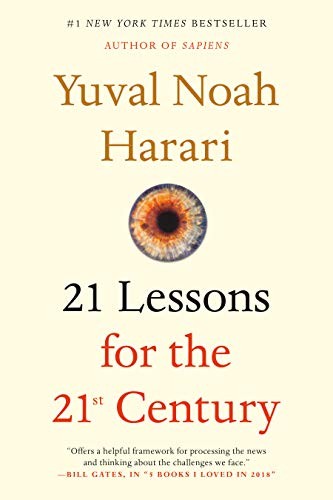
Talk to 21 Lessons for the 21st Century like its author wrote you back.
Get the ideas that fit your life — not generic summaries.
- Chat with the book
- Audiobook-style main ideas
- Adapts to your life and goals
- Helps you take action
What it argues
Where Sapiens traced humanity's past and Homo Deus speculated about its future, 21 Lessons for the 21st Century plants itself in the present. Harari sets out to answer a single question: what is actually going on right now, and what should any thoughtful person do about it? The book covers twenty-one issues — automation, nationalism, religion, terrorism, immigration, and more — in short, essayistic chapters that read more like op-eds than academic argument. That format is both the book's appeal and its limitation.
The most grounded chapters deal with technology. Harari argues that AI and automation will disrupt labor markets far more thoroughly than the industrial revolution did, not because machines are getting smarter in the way humans are, but because the combination of machine learning and big data is hollowing out cognitive work as well as manual work. The question he keeps pressing is not whether jobs will disappear but whether new ones will form fast enough, and whether the people displaced will be able to retrain in time. He is skeptical that liberal faith in education and flexibility will be adequate answers.
What it gets right
- 1.
AI and automation threaten cognitive work as deeply as manual work. The combination of machine learning and big data may eliminate entire categories of expertise, not just repetitive tasks.
- 2.
Liberal democracy's legitimacy rests on a story about individual agency and rational choice. That story becomes harder to defend when algorithms can predict and shape decisions better than individuals can.
- 3.
Nationalism offers emotional coherence but no practical framework for managing global problems like climate change, AI governance, or nuclear proliferation that require cross-border cooperation.
What it covers
Who wrote it
Yuval Noah Harari is an Israeli historian and professor at the Hebrew University of Jerusalem. He is the author of the Sapiens trilogy — Sapiens, Homo Deus, and 21 Lessons for the 21st Century — which together have sold more than 45 million copies in over 65 languages. His work spans evolutionary biology, anthropology, and political philosophy. Harari is known for synthesizing vast historical and scientific material into accessible narrative and has advised policymakers and spoken at Davos and the United Nations. He co-founded Sapienship, a social impact company focused on global challenges.
