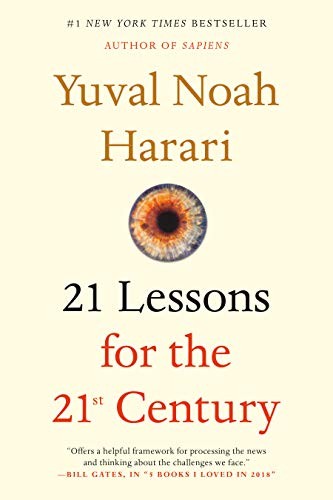
21 Lessons for the 21st Century by Yuval Noah Harari is a 2018 philosophy book about technology and society, political disillusionment, meaning. AI and automation threaten cognitive work as deeply as manual work. The combination of machine learning and big data may eliminate entire categories of expertise, not just repetitive tasks.
Summary
Where Sapiens traced humanity's past and Homo Deus speculated about its future, 21 Lessons for the 21st Century plants itself in the present. Harari sets out to answer a single question: what is actually going on right now, and what should any thoughtful person do about it? The book covers twenty-one issues — automation, nationalism, religion, terrorism, immigration, and more — in short, essayistic chapters that read more like op-eds than academic argument. That format is both the book's appeal and its limitation.
The most grounded chapters deal with technology. Harari argues that AI and automation will disrupt labor markets far more thoroughly than the industrial revolution did, not because machines are getting smarter in the way humans are, but because the combination of machine learning and big data is hollowing out cognitive work as well as manual work. The question he keeps pressing is not whether jobs will disappear but whether new ones will form fast enough, and whether the people displaced will be able to retrain in time. He is skeptical that liberal faith in education and flexibility will be adequate answers.
The political chapters are less predictive and more diagnostic. Harari is interested in why liberalism, nationalism, religion, and now technocratic globalism each fail to offer a coherent story about what the future is for. The section on information and truth is particularly timely: Harari argues that fake news is not a new problem — humans have always preferred comforting narratives to accurate ones — but that social media has dramatically shortened the feedback loop between fiction and belief. The chapter on meditation stands apart from the rest; Harari is candid that his personal practice shapes how he approaches questions of consciousness and agency, and readers who find that section too personal are not wrong to skip it.
The book's weakness is its breadth. Twenty-one topics in three hundred pages means that most chapters feel like introductions rather than deep investigations. Readers who have followed Harari through his previous two books will find some arguments repeated and few positions substantially new. Where Sapiens achieved something rare — genuine synthesis that changed how many people think about human history — 21 Lessons settles for being a thoughtful survey of anxieties most educated readers already feel. That said, few writers assemble those anxieties as clearly or connect them as fluently. As a map of the present's most important unresolved questions, it is a useful book. As an answer to any of them, it is necessarily incomplete.
Talk to 21 Lessons for the 21st Century like its author wrote you back.
Get the ideas that fit your life — not generic summaries.
- Chat with the book
- Audiobook-style main ideas
- Adapts to your life and goals
- Helps you take action
Key takeaways
- 1.
AI and automation threaten cognitive work as deeply as manual work. The combination of machine learning and big data may eliminate entire categories of expertise, not just repetitive tasks.
- 2.
Liberal democracy's legitimacy rests on a story about individual agency and rational choice. That story becomes harder to defend when algorithms can predict and shape decisions better than individuals can.
- 3.
Nationalism offers emotional coherence but no practical framework for managing global problems like climate change, AI governance, or nuclear proliferation that require cross-border cooperation.
- 4.
Humans are not uniquely rational. Every major political system — liberal, nationalist, religious — operates as a narrative that simplifies reality to the point of distortion, and people protect those narratives fiercely.
- 5.
Fake news is old. What is new is the speed and personalization with which false narratives now propagate, and the difficulty of distinguishing signal from noise at scale.
- 6.
The question of meaning is not solved by prosperity. As material conditions improve, existential questions about purpose and identity intensify rather than recede.
- 7.
Meditation and self-examination are not peripheral to Harari's argument: understanding your own mind's capacity for self-delusion is, he argues, a prerequisite for navigating a world that wants to exploit it.
- 8.
Resilience matters more than optimization. In a world where the specific skills valued today may be obsolete in twenty years, the ability to learn, adapt, and tolerate uncertainty is more durable than any particular expertise.
Discussion questions
Use these on your own, with a book club, or as chat starters in Superbook. Book club version, ready to copy or print →
- 1.
Harari argues that automation will displace cognitive as well as manual workers. Which professions in your field feel most and least at risk, and why?
- 2.
The book claims liberal democracy's legitimacy depends on a particular story about human agency. How does that story hold up against what you know about how people actually make decisions?
- 3.
Harari is skeptical that individuals can meaningfully consent to how their data is used. Do you find that argument convincing, or is it too defeatist?
- 4.
Which of the twenty-one lessons felt most urgent to you personally, and which felt most overstated?
- 5.
The nationalism chapter argues that national identity offers comfort but not solutions to global problems. Is there a version of nationalism that Harari is too quick to dismiss?
- 6.
Harari says humans are better at identifying external threats than internal ones — including the biases of our own minds. Where in your own thinking do you notice that pattern?
- 7.
The section on religion treats faith traditions primarily as meaning-making narratives. How fair do you think that framing is to people who hold sincere religious beliefs?
- 8.
Harari's chapter on meditation is explicitly personal. Does a public intellectual's private practice belong in a book like this, or is it a distraction from the political argument?
- 9.
The book argues that resilience and adaptability matter more than specific skills. What would it actually look like to optimize for those things in your own life or career?
- 10.
Harari suggests that most people will need to reinvent themselves professionally multiple times in the coming decades. What would make that easier or harder for the people you know?
- 11.
The chapter on truth argues we are not well-equipped to separate reliable information from plausible fiction. How do you personally try to manage that problem, and how well does it work?
- 12.
Where do you think Harari's argument is weakest? Which of his twenty-one lessons feels most like a placeholder for a question he couldn't fully answer?
Themes
Frequently asked questions
-
What is 21 Lessons for the 21st Century about?
The book addresses twenty-one urgent questions about the present moment — AI, political disillusionment, nationalism, terrorism, migration, and the search for meaning — in short, essayistic chapters. It is less a unified argument than a survey of the most important unresolved problems facing humanity right now.
-
Do I need to read Sapiens first?
No. The books share a worldview but each stands alone. 21 Lessons is the most topical of the three and can be read in any order. Readers who start here often go back to Sapiens, which is the stronger book.
-
How long does it take to read 21 Lessons?
Around six to seven hours at average reading pace. The chapters are short and self-contained, which makes it easy to read in sessions of twenty or thirty minutes. It does not demand to be read cover to cover in sequence.
-
Is 21 Lessons for the 21st Century worth reading?
For readers new to Harari, yes — it is a clear and wide-ranging introduction to the questions that matter most right now. Readers who finished Sapiens and Homo Deus will find some arguments familiar and the depth thinner than in those books.
-
What is the most unsettling idea in the book?
Probably Harari's argument that liberal democracy's story about individual choice is becoming incoherent as algorithms understand and shape human decisions better than individuals do. It is not a new observation, but he states it more starkly than most.
-
Who should skip this book?
Readers looking for detailed policy prescriptions or rigorous academic argument will find the format frustrating. The book raises hard questions more often than it answers them. If you want depth on any single topic — AI ethics, political philosophy, religious studies — specialist books will serve you better.
Similar books
Sapiens: A Brief History of Humankind
Yuval Noah Harari
Homo Deus: A Brief History of Tomorrow
Yuval Noah Harari
Thinking, Fast and Slow
Daniel Kahneman
The Righteous Mind: Why Good People Are Divided by Politics and Religion
Jonathan Haidt
