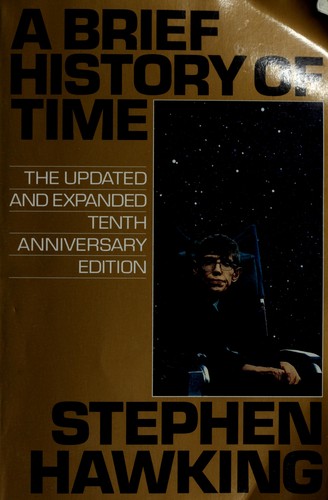
Talk to A Brief History of Time like its author wrote you back.
Get the ideas that fit your life — not generic summaries.
- Chat with the book
- Audiobook-style main ideas
- Adapts to your life and goals
- Helps you take action
A Brief History of Time, in detail
A Brief History of Time is Stephen Hawking's attempt to explain the biggest questions in physics — where the universe came from, how it behaves, and where it might be going — to readers with no scientific training. Published in 1988 and revised in 1998, it covers the Big Bang, black holes, the nature of time, and the search for a unified theory that would reconcile general relativity with quantum mechanics. Hawking's stated ambition was to make these ideas as accessible as a book about science could be without losing their substance, and by most measures he succeeded.
The first half of the book builds up the conceptual machinery: Newton's gravity, Einstein's special and general relativity, the expanding universe, and the idea that spacetime is curved by mass. Hawking explains why the universe appears to have had a beginning and introduces the notion that asking what happened before the Big Bang may be as meaningless as asking what lies south of the South Pole. From there he moves to black holes — the region of his own research — where he explains event horizons and introduces Hawking radiation, the theoretical discovery that black holes slowly emit energy and can eventually evaporate. This is a genuine scientific result, not a simplification for lay readers.
The second half addresses deeper questions: the arrow of time, why the past feels different from the future, and whether the laws of physics permit time travel or multiple universes. Hawking presents several competing theories of the universe's origin, including the no-boundary proposal he developed with James Hartle, which suggests the universe has no edge or boundary in imaginary time and therefore requires no external cause. He is honest about what remains unresolved — a final "theory of everything" was, in 1988, close to being within reach, and decades of physics since have shown that confidence to be somewhat premature.
The book is not always easy. Some passages on quantum mechanics and the geometry of spacetime demand real attention and may need re-reading. But Hawking's explanations are rarely opaque for long, and his voice carries both humor and awe. Readers looking for a narrative-driven popular science experience may prefer later books in the genre; readers who want to sit with Hawking's own thinking about the deepest questions in physics will find nothing quite like it.
The big ideas
- 1.
The universe began with the Big Bang roughly 13.8 billion years ago, and the evidence — including the expansion of galaxies and the cosmic microwave background — is overwhelming.
- 2.
General relativity describes gravity as the curvature of spacetime caused by mass. Heavy objects don't pull other objects; they bend the fabric through which those objects travel.
- 3.
Black holes are regions where gravity is so strong that not even light can escape. Their boundary — the event horizon — is a one-way surface: matter falls in, nothing comes out.
