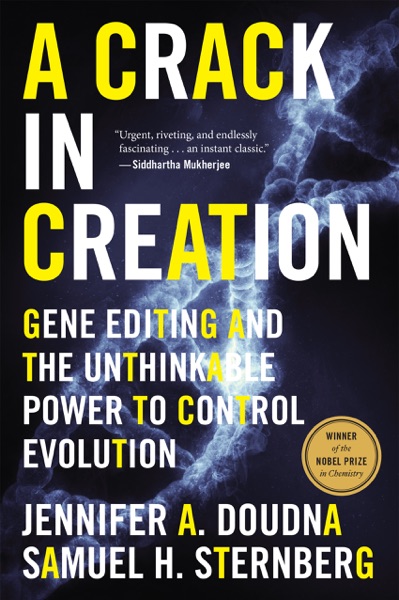
Talk to A Crack in Creation: Gene Editing and the Unthinkable Power to Control Evolution like its author wrote you back.
Get the ideas that fit your life — not generic summaries.
- Chat with the book
- Audiobook-style main ideas
- Adapts to your life and goals
- Helps you take action
What it argues
A Crack in Creation is Jennifer Doudna and Samuel Sternberg's account of how CRISPR-Cas9 works, what it can do, and why its possibilities should give everyone pause. Doudna is one of the scientists who developed the technology into a practical gene-editing tool; the book is part science explanation, part memoir, and part ethical reckoning from someone who helped create something whose implications she found troubling enough to call for a public moratorium.
The first half is a lucid account of CRISPR's molecular mechanism. CRISPR stands for clustered regularly interspaced short palindromic repeats — sequences in bacterial DNA that store fragments of viral DNA as a kind of immunological memory. The Cas9 protein acts as molecular scissors, guided by a short RNA molecule to cut a specific location in the genome. Doudna and Charpentier adapted this system into a tool for editing the genomes of plants, animals, and human cells with a precision and speed no previous technique matched. The result transformed a laborious, expensive process into something any well-equipped graduate student could learn.
What it gets right
- 1.
CRISPR-Cas9 is a bacterial immune mechanism repurposed as a molecular scissors that can cut any DNA sequence with high precision — cheaper and simpler than any previous editing technique.
- 2.
The technology has already entered clinical trials for sickle cell disease, certain cancers, and inherited blindness, with results that suggest it will become a routine medical tool.
- 3.
Gene drives can spread a CRISPR modification through an entire wild population within a few generations, raising ecological risks that are qualitatively different from other genetic interventions.
What it covers
Who wrote it
Jennifer A. Doudna is a biochemist at the University of California, Berkeley, and a Howard Hughes Medical Institute investigator. She shared the 2020 Nobel Prize in Chemistry with Emmanuelle Charpentier for the development of CRISPR-Cas9 as a gene-editing tool. Her lab continues research on CRISPR mechanisms and applications. Samuel H. Sternberg is a biochemist who completed his doctorate in Doudna's lab and has since led his own laboratory at Columbia University studying the molecular machinery of CRISPR systems.
