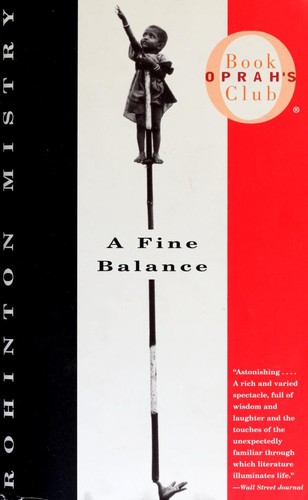
Talk to A Fine Balance like its author wrote you back.
Get the ideas that fit your life — not generic summaries.
- Chat with the book
- Audiobook-style main ideas
- Adapts to your life and goals
- Helps you take action
A Fine Balance, in detail
A Fine Balance is set in an unnamed Indian city during Indira Gandhi's Emergency of 1975–1977, a period of suspended democracy, forced sterilization, and slum clearances that is barely taught in the West and barely taught in India. Four characters find themselves sharing a small apartment: Dina, a widowed Parsi woman holding onto her independence through a tailoring business; Maneck, a young student from the mountains sent away for an education; and Ishvar and Om, Hindu tailors from a lower caste who have traveled to the city after caste violence destroyed their family. The novel follows them over roughly a year as the Emergency tightens and each of their lives is irrevocably damaged.
The book is about what it costs to survive an indifferent system, and what survives in people after the system is done with them. Mistry draws the Emergency with documentarian precision — the forced sterilization camps, the demolition squads, the petty officials with catastrophic power over ordinary lives — without ever letting politics overwhelm his characters. Ishvar and Om are drawn with immense affection, and their friendship with Dina is the emotional spine of the novel. The comedy in their domestic arrangements is genuine and warm, which makes what happens to them more devastating.
Mistry's prose is traditional nineteenth-century realism — Dickens is the obvious comparison, and he earns it. The novel is long, dense, and unsparing. Unlike Dickens, there is no safety net of coincidence or reform. The arc is not redemptive. People are broken, and Mistry looks at the breakage with steady eyes and does not look away. There is one direct structural reference to Voltaire's Candide — "we must cultivate our garden" becomes the novel's most ironized line — and it captures the book's worldview precisely.
A Fine Balance will reward readers willing to commit to its length. It is not a comfortable book. The suffering is cumulative, specific, and earns every page. Readers looking for uplift or historical optimism should look elsewhere. But for those who want fiction that takes the lived experience of poverty and political violence as seriously as any literary tradition offers, this is among the very best novels written in the latter half of the twentieth century.
The big ideas
- 1.
The Emergency of 1975-77 is one of Indian history's most consequential and least remembered periods in Western consciousness; Mistry makes it visceral and specific.
- 2.
Caste is not background texture in the novel — it is mechanism. Ishvar and Om's vulnerability is precisely calibrated to their caste position, and Mistry traces this without abstraction.
- 3.
Mistry's comedy is not relief from the horror but its companion. The warmth of the apartment scenes and the cold violence of the state exist simultaneously throughout.
