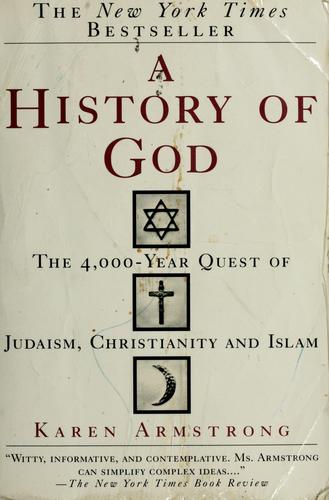
Talk to A History of God like its author wrote you back.
Get the ideas that fit your life — not generic summaries.
- Chat with the book
- Audiobook-style main ideas
- Adapts to your life and goals
- Helps you take action
What it argues
A History of God is Karen Armstrong's account of how the idea of God has changed over four thousand years across Judaism, Christianity, and Islam, with excursions into Hinduism and Buddhism. The organizing thesis is that the human conception of God is not static and never has been. The God of Abraham, the God of the philosophers, the personal God of mystics, and the God of modern fundamentalism are genuinely different constructions — responses to different historical circumstances and human needs.
Armstrong begins in ancient Mesopotamia and early Israel, where the God of the Hebrews emerged from a polytheistic environment and gradually became identified as the sole deity of the universe. She traces the development of Jewish theology through the Babylonian exile and the rabbinic period, then follows Christianity's encounter with Greek philosophy, which transformed the Hebrew God into the abstract, timeless being of Neoplatonism. Islamic theology from Muhammad through the Sufi mystical tradition forms the third major thread, and Armstrong argues repeatedly that the three Abrahamic traditions have more in common with each other — especially in their mystical strands — than popular understanding suggests.
What it gets right
- 1.
The idea of God has changed continuously over four thousand years. There is no single Jewish, Christian, or Islamic conception of God — each tradition contains wide variation across time.
- 2.
The Hebrew God emerged from polytheism gradually. Early Israelite religion was henotheistic — one God among many — not strictly monotheistic.
- 3.
Greek philosophy radically transformed Christian and Islamic theology. The God of Augustine and Aquinas owes more to Plato and Aristotle than to the God of Abraham.
What it covers
Who wrote it
Karen Armstrong is a British author and former Roman Catholic nun who left her convent in 1969 after seven years. She subsequently became one of the world's leading commentators on religion, writing more than twenty books on subjects ranging from early Christianity and Islam to the Buddha and the Hebrew Bible. Her other major works include The Case for God, The Battle for God, Muhammad, Buddha, and Fields of Blood. She founded the Charter for Compassion in 2008 and has received honorary doctorates from universities in multiple countries.
