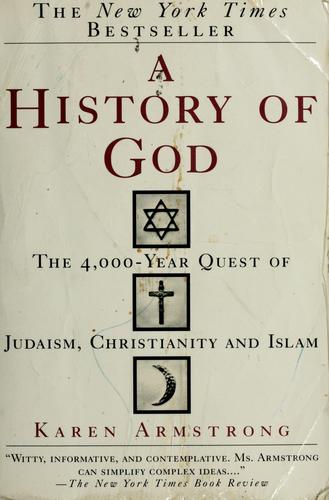
A History of God by Karen Armstrong is a 1993 religion & spirituality book about monotheism, theology, religious history. The idea of God has changed continuously over four thousand years. There is no single Jewish, Christian, or Islamic conception of God — each tradition contains wide variation across time.
Summary
A History of God is Karen Armstrong's account of how the idea of God has changed over four thousand years across Judaism, Christianity, and Islam, with excursions into Hinduism and Buddhism. The organizing thesis is that the human conception of God is not static and never has been. The God of Abraham, the God of the philosophers, the personal God of mystics, and the God of modern fundamentalism are genuinely different constructions — responses to different historical circumstances and human needs.
Armstrong begins in ancient Mesopotamia and early Israel, where the God of the Hebrews emerged from a polytheistic environment and gradually became identified as the sole deity of the universe. She traces the development of Jewish theology through the Babylonian exile and the rabbinic period, then follows Christianity's encounter with Greek philosophy, which transformed the Hebrew God into the abstract, timeless being of Neoplatonism. Islamic theology from Muhammad through the Sufi mystical tradition forms the third major thread, and Armstrong argues repeatedly that the three Abrahamic traditions have more in common with each other — especially in their mystical strands — than popular understanding suggests.
A recurring theme is the tension between two modes of religious experience: the God of the philosophers, reached through reason and contemplation, and the God of personal encounter, who speaks to prophets and answers prayers. The mystical traditions in all three religions — Kabbalah, Sufism, Christian apophatic theology — consistently dissolved this personal God into something more like ground of being or ineffable mystery.
The final chapters examine the twentieth century, where fundamentalism in all three traditions responded to the pressures of modernism by insisting on literal reading and factual claims. Armstrong sees fundamentalism as an anxious reaction to the collapse of traditional societies rather than a return to original religion. The book ends on an ambiguous note: the God of traditional theology may be philosophically untenable for many modern people, yet the human need that religion addresses has not disappeared.
Talk to A History of God like its author wrote you back.
Get the ideas that fit your life — not generic summaries.
- Chat with the book
- Audiobook-style main ideas
- Adapts to your life and goals
- Helps you take action
Key takeaways
- 1.
The idea of God has changed continuously over four thousand years. There is no single Jewish, Christian, or Islamic conception of God — each tradition contains wide variation across time.
- 2.
The Hebrew God emerged from polytheism gradually. Early Israelite religion was henotheistic — one God among many — not strictly monotheistic.
- 3.
Greek philosophy radically transformed Christian and Islamic theology. The God of Augustine and Aquinas owes more to Plato and Aristotle than to the God of Abraham.
- 4.
Mystical traditions in all three Abrahamic faiths converge on the apophatic: God is beyond human concepts, and any positive description is a limitation imposed by our minds.
- 5.
The Sufi, Kabbalist, and Christian contemplative traditions saw the mystic's goal as dissolution of the self — the ordinary ego must die before the encounter with God is possible.
- 6.
Fundamentalism across all three traditions emerged in the twentieth century as a defensive reaction to modernism, not a revival of ancient practice.
- 7.
The God of the philosophers — timeless, impassible, without emotion — and the God of scripture — angry, jealous, loving — have never been fully reconciled in any of the three traditions.
- 8.
Human beings have consistently generated religion throughout history. Armstrong argues this suggests it meets a genuine psychological or existential need, whatever metaphysical claims we make.
Discussion questions
Use these on your own, with a book club, or as chat starters in Superbook. Book club version, ready to copy or print →
- 1.
Armstrong argues the idea of God changes in response to historical circumstances. Does this evolutionary account strengthen or weaken the claim that there is something real that religion is tracking?
- 2.
The God of Abraham acts in history — parting seas, dictating commands. The God of Plotinus is beyond time and history. Can both be versions of the same God, or are they different concepts?
- 3.
Armstrong shows that monotheism emerged gradually from polytheism. Does the origin of an idea tell you anything about its truth?
- 4.
The mystical traditions all converge on silence and unsayability. Does that convergence seem like evidence for a genuine reality, or like a common psychological experience with many explanations?
- 5.
Fundamentalism, in Armstrong's account, is a modern phenomenon rather than a continuity with ancient religion. Does this framing seem accurate when you look at movements you know?
- 6.
Each Abrahamic tradition has a mystical strand that most practitioners never encounter. Who do you think the typical believer in each tradition is closer to — the philosopher-theologians or the popular folk religion?
- 7.
Armstrong traces the influence of Greek philosophy on Christian theology. Does it change your view of Christianity to see how thoroughly it absorbed Platonic categories?
- 8.
The God of the mystics is so abstract it can barely be called personal. Does a God that is 'ground of being' rather than a person seem like a meaningful object of worship?
- 9.
All three traditions have developed their God-concept partly in response to philosophical objections and historical catastrophes. What current pressures do you think are reshaping religious ideas right now?
- 10.
Armstrong writes as a sympathetic outsider — not a believer, but not hostile either. Does that position give her account credibility or does it limit it?
- 11.
If God is constructed differently in each era, what stays constant? Is there a minimal core that makes the comparison across four thousand years meaningful?
- 12.
Which strand of the tradition — the philosopher's God, the prophet's God, or the mystic's God — seems most compelling or most honest to you? Why?
Themes
Frequently asked questions
-
What is A History of God about?
It traces how human beings have understood God over four thousand years in Judaism, Christianity, and Islam, arguing that the concept has changed dramatically across time, cultures, and circumstances.
-
Is A History of God anti-religious?
No. Armstrong is sympathetic to religious experience while skeptical of dogmatism. She argues that sophisticated theology across the traditions is more intellectually honest than either fundamentalism or dismissive atheism.
-
How long does it take to read A History of God?
At average reading pace, roughly eleven to twelve hours. It is a long and dense book covering vast historical and theological ground, best read in sections with time to absorb each period.
-
Do I need prior knowledge of theology to read it?
Some familiarity with the Bible and basic history helps, but Armstrong explains her terms and provides context throughout. Readers unfamiliar with Islamic or Jewish theology will learn a great deal.
-
Who should read this book?
Anyone interested in the history of religion, religious philosophy, or the roots of the three Abrahamic faiths. It's particularly valuable for people who want to understand fundamentalism historically rather than treating it as primordial.