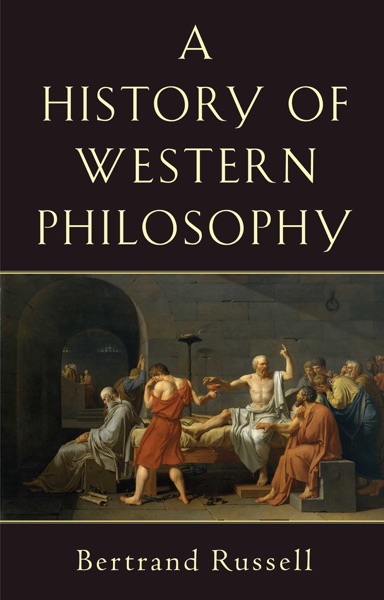
Talk to A History of Western Philosophy like its author wrote you back.
Get the ideas that fit your life — not generic summaries.
- Chat with the book
- Audiobook-style main ideas
- Adapts to your life and goals
- Helps you take action
A History of Western Philosophy, in detail
A History of Western Philosophy is Bertrand Russell's single-volume account of Western philosophical thought from the pre-Socratics through Aristotle, the Stoics, medieval Scholasticism, the Renaissance, the empiricists and rationalists, Kant, German Idealism, and the nineteenth and early twentieth centuries. Russell wrote it in the early 1940s, intended partly as a contribution to the war effort — an argument for liberal and democratic values against totalitarianism — and partly as a popular work that would finance his return to lecturing after financial difficulties. It won him the Nobel Prize in Literature in 1950.
The book is organized into three parts: ancient, Catholic, and modern philosophy. Each section traces not just the arguments philosophers made but the social and political circumstances in which they made them. Russell was convinced that ideas cannot be understood in isolation from their historical context, and the book is as much cultural history as philosophy. The pre-Socratic section is among its best — Heraclitus, Parmenides, Pythagoras, and Democritus are brought to life as intellectual figures responding to real questions about nature and mathematics. The treatment of Plato and Aristotle is thorough without being exhaustive.
Russell's sympathies and antipathies are never hidden. He is consistently critical of Plato's authoritarianism, deeply ambivalent about Aristotle, dismissive of much of medieval Scholasticism, admiring of the empiricists (especially Hume), and engaged, if sometimes unfair, with the Germans. His treatment of Hegel and Nietzsche is explicitly hostile, arguing that their ideas contributed to the intellectual conditions for fascism — a view that many subsequent scholars have found tendentious. Whether you share his assessments or not, they make the book livelier than neutral surveys do.
The book has obvious limitations as a scholarly work. Russell simplifies, occasionally misreads, and pursues his own intellectual interests at the expense of figures he finds less interesting. But as an introduction to two and a half millennia of philosophical thought, written by one of the twentieth century's greatest philosophical minds with genuine rhetorical skill, it remains a remarkable achievement. The best way to use it is as a vivid entry point, not a definitive reference.
The big ideas
- 1.
Philosophy must be understood in its historical and social context. Ideas emerge from specific circumstances, address specific problems, and cannot be properly evaluated in isolation from them.
- 2.
The pre-Socratics asked the founding questions of Western philosophy: What is the basic substance of the world? Is change or permanence more real? These questions echo through the entire subsequent tradition.
- 3.
Plato's philosophy is beautiful and ambitious, but its political implications — the philosopher-king, the dismissal of democracy, the suspicion of art — are, in Russell's reading, essentially authoritarian.
