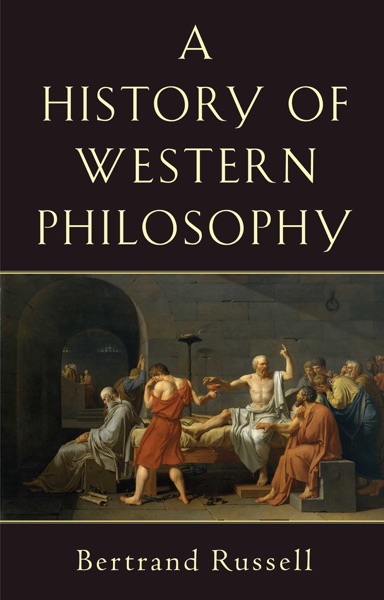
A History of Western Philosophy by Bertrand Russell is a 1945 philosophy book about philosophy and history, reason and religion, political thought. Philosophy must be understood in its historical and social context. Ideas emerge from specific circumstances, address specific problems, and cannot be properly evaluated in isolation from them.
Summary
A History of Western Philosophy is Bertrand Russell's single-volume account of Western philosophical thought from the pre-Socratics through Aristotle, the Stoics, medieval Scholasticism, the Renaissance, the empiricists and rationalists, Kant, German Idealism, and the nineteenth and early twentieth centuries. Russell wrote it in the early 1940s, intended partly as a contribution to the war effort — an argument for liberal and democratic values against totalitarianism — and partly as a popular work that would finance his return to lecturing after financial difficulties. It won him the Nobel Prize in Literature in 1950.
The book is organized into three parts: ancient, Catholic, and modern philosophy. Each section traces not just the arguments philosophers made but the social and political circumstances in which they made them. Russell was convinced that ideas cannot be understood in isolation from their historical context, and the book is as much cultural history as philosophy. The pre-Socratic section is among its best — Heraclitus, Parmenides, Pythagoras, and Democritus are brought to life as intellectual figures responding to real questions about nature and mathematics. The treatment of Plato and Aristotle is thorough without being exhaustive.
Russell's sympathies and antipathies are never hidden. He is consistently critical of Plato's authoritarianism, deeply ambivalent about Aristotle, dismissive of much of medieval Scholasticism, admiring of the empiricists (especially Hume), and engaged, if sometimes unfair, with the Germans. His treatment of Hegel and Nietzsche is explicitly hostile, arguing that their ideas contributed to the intellectual conditions for fascism — a view that many subsequent scholars have found tendentious. Whether you share his assessments or not, they make the book livelier than neutral surveys do.
The book has obvious limitations as a scholarly work. Russell simplifies, occasionally misreads, and pursues his own intellectual interests at the expense of figures he finds less interesting. But as an introduction to two and a half millennia of philosophical thought, written by one of the twentieth century's greatest philosophical minds with genuine rhetorical skill, it remains a remarkable achievement. The best way to use it is as a vivid entry point, not a definitive reference.
Talk to A History of Western Philosophy like its author wrote you back.
Get the ideas that fit your life — not generic summaries.
- Chat with the book
- Audiobook-style main ideas
- Adapts to your life and goals
- Helps you take action
Key takeaways
- 1.
Philosophy must be understood in its historical and social context. Ideas emerge from specific circumstances, address specific problems, and cannot be properly evaluated in isolation from them.
- 2.
The pre-Socratics asked the founding questions of Western philosophy: What is the basic substance of the world? Is change or permanence more real? These questions echo through the entire subsequent tradition.
- 3.
Plato's philosophy is beautiful and ambitious, but its political implications — the philosopher-king, the dismissal of democracy, the suspicion of art — are, in Russell's reading, essentially authoritarian.
- 4.
Empiricism (Locke, Berkeley, Hume) and rationalism (Descartes, Leibniz, Spinoza) represent the two fundamental options for grounding knowledge, and the tension between them defines much of modern philosophy.
- 5.
Hume's radical skepticism — about causation, the self, inductive reasoning — set the problem that Kant spent his career trying to solve, and which has not been fully solved since.
- 6.
German Idealism from Kant through Hegel to Marx represents one of the most sustained and ambitious attempts to systematize human knowledge — and, in Russell's view, one of the most dangerous in its political consequences.
- 7.
Russell sees the history of philosophy as a long oscillation between mysticism (the view that ultimate reality is beyond reason) and science (the view that reason and evidence are the only reliable guides to knowledge).
- 8.
Reading philosophy is not a passive activity. Each philosopher poses questions that the reader must decide whether to accept — and the history of philosophy is a conversation across centuries in which the reader can participate.
Discussion questions
Use these on your own, with a book club, or as chat starters in Superbook. Book club version, ready to copy or print →
- 1.
Russell writes with strong opinions about nearly every philosopher. Does his argumentativeness make the book more or less useful as an introduction — and does it affect how you receive the philosophers he's hostile to?
- 2.
The book argues that philosophy must be understood in its social and political context. Can you think of philosophical ideas you've encountered whose historical context significantly changed their meaning for you?
- 3.
Russell is deeply sympathetic to the empiricists and deeply hostile to the German Idealists. Is this a principled philosophical position or a cultural and political one — and can you separate them?
- 4.
Hume concluded that inductive reasoning cannot be rationally justified — we have no logical basis for assuming the future will resemble the past. Does this argument still trouble you, or have you found a response that satisfies you?
- 5.
Russell suggests Plato's thought contains the seeds of authoritarianism. Having read some Plato, do you find this reading fair, or does it miss something important about what Plato was trying to do?
- 6.
The book was partly written to defend liberal democracy against fascism in the 1940s. Does knowing that purpose change how you read its judgments about philosophers like Nietzsche and Hegel?
- 7.
Medieval Scholasticism takes up a large portion of the book and gets relatively little sympathy from Russell. What, if anything, does the period contribute to philosophy — or was Russell right to treat it as a long detour?
- 8.
If you had to identify the single question that runs through the entire history of Western philosophy as Russell tells it, what would you say it is?
- 9.
Russell himself believed that logic and mathematics provided the model for philosophical clarity. Does his own philosophical work — the theory of types, logical atomism — seem to bear that out?
- 10.
Is it possible to write a genuinely neutral history of philosophy, or does any such project inevitably reflect its author's philosophical commitments? What would be gained or lost by greater neutrality?
- 11.
Which philosopher in the book do you find most interesting or alive — and does Russell's treatment help or hinder your engagement with them?
- 12.
The book ends with James and Dewey and early analytic philosophy — Russell's own tradition. Does the narrative feel like it has been driving toward that conclusion all along?
Themes
Frequently asked questions
-
What is A History of Western Philosophy about?
It's Bertrand Russell's survey of Western philosophical thought from the ancient Greeks through the early twentieth century, organized by period and written with genuine narrative skill and strong personal opinions. It covers the pre-Socratics, Plato, Aristotle, the Stoics, medieval philosophy, the early moderns, Kant, Hegel, and the development of analytic and pragmatist philosophy.
-
How accurate is Russell's history?
As a popular introduction it's generally reliable, but scholars have long criticized specific readings — particularly of Hegel, Nietzsche, and some medieval figures, where Russell's hostility produces distortions. It's best used as an introduction that sends you to primary sources, not as a definitive account.
-
How long does it take to read?
At average reading pace, around 18 to 20 hours for the full 895-page text. Most readers take it in sections over weeks or months, returning to chapters on philosophers they want to explore further. The writing is fluid enough that it reads faster than its length suggests.
-
Is A History of Western Philosophy a good starting point for learning philosophy?
It's an excellent starting point for readers who want a sense of the whole tradition before going deeper. Its narrative sweep and strong point of view make the material vivid. For anyone who wants to go deeper in specific areas, it should be supplemented with better-sourced introductions or primary texts.
-
Why did Russell write this book?
He wrote it in the early 1940s while in financial difficulty after losing his position at City College of New York. It was partly a commercial project intended to fund his return to academic work, and partly a political one — an argument for liberal, reason-based values against the totalitarianisms then threatening Europe. Both motivations are legible in the text.