Talk to A Man for All Markets like its author wrote you back.
Get the ideas that fit your life — not generic summaries.
- Chat with the book
- Audiobook-style main ideas
- Adapts to your life and goals
- Helps you take action
What it argues
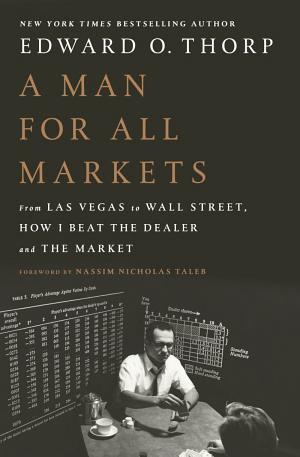
A Man for All Markets is Edward Thorp's memoir of a life spent finding mathematical edges — first in casinos and later in financial markets. Thorp is the mathematician who invented card counting as a systematic strategy, wrote Beat the Dealer in 1962 to teach it to the public, and then applied the same probabilistic thinking to warrant pricing and statistical arbitrage, becoming one of the most successful hedge fund managers of his era. The memoir covers both phases of his career alongside his life, his values, and his observations about risk, wealth, and probability.
The casino section is the more colorful half of the book. Thorp describes how he built mathematical models of blackjack that turned a negative-expected-value game into a positive one for a skilled card counter. He then went to Las Vegas to test the theory, was threatened, had his drink spiked, was eventually identified and barred, and watched the casinos gradually change their rules in response to his published work. The experience is a study in how institutions respond to someone who has found a legitimate edge: first disbelief, then accommodation, then structural change to eliminate the advantage.
What it gets right
- 1.
Finding a genuine edge — a situation where your expected value is positive — is the prerequisite for sustainable winning in both gambling and investing.
- 2.
The Kelly criterion provides a mathematically optimal bet-sizing formula: bet a fraction of capital proportional to your edge divided by the odds. Overbetting destroys compounding; underbetting wastes it.
- 3.
Card counting in blackjack is fundamentally the same intellectual move as statistical arbitrage in markets: tracking information that shifts the probability distribution away from the casino's or market's assumed baseline.
What it covers
Who wrote it
Edward O. Thorp is an American mathematician, author, and hedge fund manager. He earned his PhD in mathematics from UCLA and taught at MIT and UC Irvine before his work on blackjack and markets made full-time academic life difficult to reconcile with his other activities. He is the author of Beat the Dealer, the first book to use mathematical analysis to show that blackjack could be beaten, and Beat the Market, co-authored with Sheen Kassouf, which introduced options pricing concepts later refined into the Black-Scholes model. Princeton-Newport Partners, which he co-founded, returned over 20 percent annually net of fees over nearly two decades.
