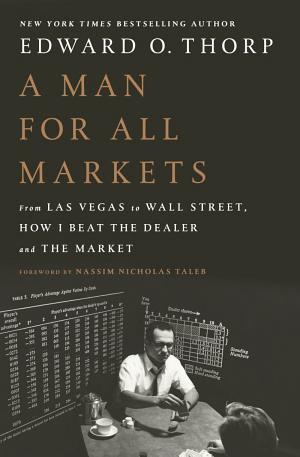
A Man for All Markets by Edward O. Thorp is a 2017 memoir book about quantitative investing, probability, gambling. Finding a genuine edge — a situation where your expected value is positive — is the prerequisite for sustainable winning in both gambling and investing.
Summary
A Man for All Markets is Edward Thorp's memoir of a life spent finding mathematical edges — first in casinos and later in financial markets. Thorp is the mathematician who invented card counting as a systematic strategy, wrote Beat the Dealer in 1962 to teach it to the public, and then applied the same probabilistic thinking to warrant pricing and statistical arbitrage, becoming one of the most successful hedge fund managers of his era. The memoir covers both phases of his career alongside his life, his values, and his observations about risk, wealth, and probability.
The casino section is the more colorful half of the book. Thorp describes how he built mathematical models of blackjack that turned a negative-expected-value game into a positive one for a skilled card counter. He then went to Las Vegas to test the theory, was threatened, had his drink spiked, was eventually identified and barred, and watched the casinos gradually change their rules in response to his published work. The experience is a study in how institutions respond to someone who has found a legitimate edge: first disbelief, then accommodation, then structural change to eliminate the advantage.
The financial markets section covers the founding of Princeton-Newport Partners, one of the first quantitative hedge funds, which produced exceptional risk-adjusted returns over nearly two decades. Thorp describes the statistical arbitrage strategies that drove performance, the culture of rigorous analysis over intuition, and his eventual encounter with Bernie Madoff — whom he identified as fraudulent based on straightforward quantitative analysis years before the SEC did.
What makes the memoir worth reading beyond its entertainment value is Thorp's consistent framework: find the edge, size the bet appropriately using the Kelly criterion, and ignore what everyone else is doing. He's genuinely humble about what he doesn't know and precise about what he does. The book is also an unusually candid look at the early development of quantitative finance from someone who was there for it.
Talk to A Man for All Markets like its author wrote you back.
Get the ideas that fit your life — not generic summaries.
- Chat with the book
- Audiobook-style main ideas
- Adapts to your life and goals
- Helps you take action
Key takeaways
- 1.
Finding a genuine edge — a situation where your expected value is positive — is the prerequisite for sustainable winning in both gambling and investing.
- 2.
The Kelly criterion provides a mathematically optimal bet-sizing formula: bet a fraction of capital proportional to your edge divided by the odds. Overbetting destroys compounding; underbetting wastes it.
- 3.
Card counting in blackjack is fundamentally the same intellectual move as statistical arbitrage in markets: tracking information that shifts the probability distribution away from the casino's or market's assumed baseline.
- 4.
Institutions react to someone with a genuine edge by first denying it, then exploiting it themselves, then changing the rules to eliminate it. This dynamic plays out in both casinos and financial markets.
- 5.
Madoff's returns were mathematically impossible given the stated strategy. Thorp identified the fraud through straightforward analysis of return characteristics rather than investigative work.
- 6.
Risk management through diversification and position sizing matters more over a career than any single trade. Thorp's returns were not from spectacular calls but from consistently correct sizing.
- 7.
Scientific thinking applied to personal finance — removing emotion, quantifying risk, making decisions based on expected value rather than narrative — produces better outcomes than expert intuition alone.
- 8.
Wealth beyond a certain point requires different skills to manage than wealth below it. The behavioral and legal complexity of significant assets is not well understood by people acquiring them for the first time.
Discussion questions
Use these on your own, with a book club, or as chat starters in Superbook. Book club version, ready to copy or print →
- 1.
Thorp applied the same framework to blackjack and to financial markets. What is that framework, and how transferable do you think it is to contexts outside mathematics?
- 2.
The Kelly criterion gives you the mathematically optimal bet size. What makes it hard to follow in practice, even when you believe you have an edge?
- 3.
Thorp identified Madoff as fraudulent years before the scandal broke and chose not to invest but also not to report him publicly. How do you think about that decision?
- 4.
The casinos eventually changed their rules when Thorp's edge was too well-known. How do financial markets do the same thing — eliminate edges once they're widely discovered?
- 5.
Thorp comes from academic mathematics rather than finance. How does that background shape his approach differently from someone trained in traditional investing?
- 6.
The memoir describes Princeton-Newport Partners being targeted in a government investigation that Thorp believed was motivated by an unrelated prosecution. How did that experience shape his views on the relationship between wealth, law, and institutional power?
- 7.
Thorp is unusually candid about his mistakes and his uncertainties alongside his successes. How does that quality affect your reception of his claims about what worked?
- 8.
The book covers five decades of financial and casino markets. What surprised you most about how markets or gambling operations worked in earlier eras compared to today?
- 9.
Thorp's edge in blackjack came from information the casino didn't properly account for. What are the analogous information edges in today's financial markets, and who holds them?
- 10.
Thorp describes building significant wealth through rigorous mathematical work. How does his story compare to the conventional narratives about how wealth is built in America?
- 11.
The second half of the book addresses how Thorp managed his personal finances and what he learned about wealth. What was the most surprising or useful observation from that section?
- 12.
Thorp says the Kelly criterion is nearly universally ignored by professional investors despite its theoretical optimality. Why do you think that is?
Themes
Frequently asked questions
-
Is A Man for All Markets worth reading?
Yes. It's one of the best memoirs in financial literature — a genuine intellectual adventure story that also contains real substance about probability, risk management, and market structure. Even readers with little interest in quant finance will find the casino sections compelling.
-
How long does it take to read?
Around six to seven hours. The book is thorough and covers a long career. The casino and early market sections move quickly; the later chapters on hedge fund operations and personal finance are denser.
-
What is the Kelly criterion and why does Thorp emphasize it?
The Kelly criterion is a formula for sizing bets or investments based on your edge and the odds, designed to maximize the long-term growth rate of capital. Thorp emphasizes it because overbetting — even with a genuine edge — can lead to ruin, while underbetting wastes compounding potential.
-
Do you need a math background to enjoy this book?
No. Thorp explains mathematical concepts clearly for a general audience, and the memoir frame means you can follow the narrative without engaging every technical detail. The casino stories in particular require no mathematical background at all.
-
How does this book compare to Beat the Dealer?
Beat the Dealer is a technical manual for card counters; A Man for All Markets is a memoir that covers his entire career. The memoir includes the blackjack story but then takes it much further into quantitative finance and personal philosophy. Most readers will find the memoir more broadly useful.