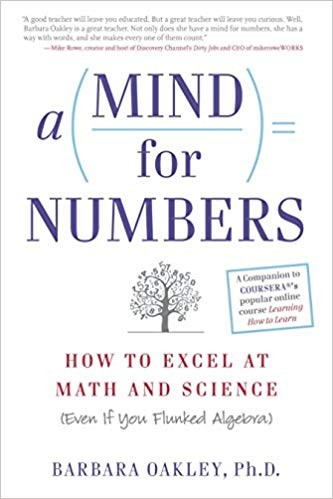
Talk to A Mind for Numbers like its author wrote you back.
Get the ideas that fit your life — not generic summaries.
- Chat with the book
- Audiobook-style main ideas
- Adapts to your life and goals
- Helps you take action
What it argues
A Mind for Numbers is Barbara Oakley's guide to learning hard subjects effectively, written primarily for students struggling with mathematics and science but drawing on cognitive science principles that apply to any demanding field. Oakley came to this subject personally: she was a self-described math-phobe who enlisted in the military out of high school, failed repeatedly at quantitative subjects, and then in her late twenties decided to completely rebuild her mathematical ability from scratch. She eventually became a professor of engineering.
The book's central framework is the distinction between two modes of thinking: focused mode and diffuse mode. Focused mode is concentrated, direct attention — what you use when actively working through a problem. Diffuse mode is the relaxed, background processing that your brain does when you step away. Oakley argues that both modes are necessary for learning, and that most students sabotage themselves by staying in focused mode too long when stuck, rather than allowing the diffuse mode to work.
What it gets right
- 1.
The focused mode and diffuse mode are both necessary for deep learning. Alternating between them — working hard, then stepping away — is more effective than grinding in focused mode alone.
- 2.
Procrastination is avoidance of the discomfort of starting. The Pomodoro technique — twenty-five minutes of focused work with no distractions — addresses the trigger, not the outcome, reducing the discomfort of beginning.
- 3.
Active recall — retrieving information from memory, not re-reading it — is the most effective learning technique. Testing yourself is more valuable than reviewing notes.
What it covers
Who wrote it
Barbara Oakley is a professor of engineering at Oakland University in Michigan and a clinical professor of engineering at McMaster University. She is also the co-creator of Learning How to Learn, which became one of the most popular online courses in history with more than three million students. Her personal story — rebuilding her mathematical abilities as an adult after years of failure — shapes all of her writing. A Mind for Numbers was published in 2014 and she followed it with Mindshift and, with Olav Schewe, Learn Like a Pro.
