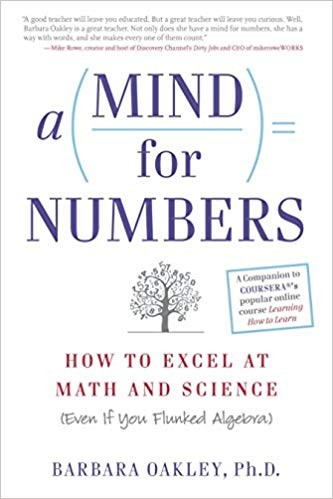
A Mind for Numbers by Barbara Oakley is a 2014 self-help book about learning, mathematics, study techniques. The focused mode and diffuse mode are both necessary for deep learning. Alternating between them — working hard, then stepping away — is more effective than grinding in focused mode alone.
Summary
A Mind for Numbers is Barbara Oakley's guide to learning hard subjects effectively, written primarily for students struggling with mathematics and science but drawing on cognitive science principles that apply to any demanding field. Oakley came to this subject personally: she was a self-described math-phobe who enlisted in the military out of high school, failed repeatedly at quantitative subjects, and then in her late twenties decided to completely rebuild her mathematical ability from scratch. She eventually became a professor of engineering.
The book's central framework is the distinction between two modes of thinking: focused mode and diffuse mode. Focused mode is concentrated, direct attention — what you use when actively working through a problem. Diffuse mode is the relaxed, background processing that your brain does when you step away. Oakley argues that both modes are necessary for learning, and that most students sabotage themselves by staying in focused mode too long when stuck, rather than allowing the diffuse mode to work.
Procrastination gets its own extended treatment. Oakley reframes it not as a character flaw but as a habitual avoidance of the discomfort of starting difficult work. She introduces the Pomodoro technique as a tool for getting started: twenty-five minutes of focused work followed by a break, with the process repeated. The focus is on the process — showing up — rather than on the outcome, which takes the pressure off.
The book also covers active recall, spaced repetition, interleaving, chunking, and the importance of sleep for memory consolidation. Oakley writes in a direct, warm, sometimes humorous voice. The book is particularly useful for anyone who has been told — or has told themselves — that they simply are not a math or science person.
Talk to A Mind for Numbers like its author wrote you back.
Get the ideas that fit your life — not generic summaries.
- Chat with the book
- Audiobook-style main ideas
- Adapts to your life and goals
- Helps you take action
Key takeaways
- 1.
The focused mode and diffuse mode are both necessary for deep learning. Alternating between them — working hard, then stepping away — is more effective than grinding in focused mode alone.
- 2.
Procrastination is avoidance of the discomfort of starting. The Pomodoro technique — twenty-five minutes of focused work with no distractions — addresses the trigger, not the outcome, reducing the discomfort of beginning.
- 3.
Active recall — retrieving information from memory, not re-reading it — is the most effective learning technique. Testing yourself is more valuable than reviewing notes.
- 4.
Spaced repetition — reviewing material at expanding intervals — builds durable long-term memory far more efficiently than massed practice or cramming.
- 5.
Interleaving — mixing different types of problems in practice — is more effective for developing flexible understanding than blocked practice of one type at a time.
- 6.
Chunking is the process of building compact, well-practiced neural patterns that allow complex information to be handled as single units. Expert intuition is built from thousands of chunks.
- 7.
Sleep is not optional for learning. Memory consolidation happens during sleep; cramming through the night not only fails to produce retention but actively degrades what was already learned.
- 8.
The illusion of competence — confusing familiarity with mastery — is the most common learning error. You must test yourself to distinguish one from the other.
Discussion questions
Use these on your own, with a book club, or as chat starters in Superbook. Book club version, ready to copy or print →
- 1.
Oakley spent years believing she couldn't do math, then rebuilt her abilities from scratch. What subjects or skills have you written off for yourself that might be more learnable than you believe?
- 2.
Think of a time when you stepped away from a hard problem and the solution appeared unexpectedly. Was that diffuse-mode processing? Could you engineer more of that deliberately?
- 3.
Which of your current study or learning practices most relies on re-reading and review rather than active recall? What would replacing it with testing look like?
- 4.
Oakley's treatment of procrastination reframes it as pain avoidance rather than laziness. Does that change how you think about your own avoidance patterns?
- 5.
When have you most vividly experienced the illusion of competence — felt fluent about something you turned out not to really know? What revealed the gap?
- 6.
She recommends the Pomodoro technique specifically as a tool for starting. Have you tried it? If not, what stops you from running a one-week experiment?
- 7.
What is the most important subject you're currently trying to learn? Which of the techniques in the book — spaced repetition, interleaving, active recall — is most absent from your current approach?
- 8.
Oakley writes about her transition from math-avoider to engineer. What does her story suggest about the relationship between self-narrative and actual ability?
- 9.
Interleaving feels less efficient and more confusing than blocked practice, but produces better long-term results. Where in your current learning are you defaulting to the comfortable blocked approach?
- 10.
How does sleep figure into your current learning routine? Would you be willing to experiment with making adequate sleep a non-negotiable learning variable for two weeks?
- 11.
The book is aimed at students but applies to professionals. Which ideas translate most directly to how you learn new skills or information in your current work?
Themes
Frequently asked questions
-
Is A Mind for Numbers worth reading?
Yes, particularly if you've struggled with math, science, or any demanding subject and attributed the struggle to lack of talent. The cognitive science is solid and the practical advice is specific. It is more actionable than most learning books.
-
How long does it take to read A Mind for Numbers?
About four hours at average pace. The chapters are short and end with summaries and takeaways. It can be read cover to cover or consulted chapter by chapter for specific learning challenges.
-
Is A Mind for Numbers only for math students?
No. The title emphasizes math because Oakley's personal story centers on it, but the principles — focused and diffuse modes, active recall, spaced repetition, avoiding procrastination — apply to learning anything difficult.
-
What is the single most important technique in A Mind for Numbers?
Active recall: retrieving information from memory rather than reviewing it. Re-reading notes produces familiarity; attempting to recall without looking produces actual retention. The discomfort of struggling to remember is the productive mechanism, not a sign of failure.
-
How does A Mind for Numbers relate to Make It Stick?
A Mind for Numbers covers similar cognitive science — retrieval practice, spacing, interleaving — but is more personal, narrative-driven, and focused on students. Make It Stick is denser and more research-focused and covers additional mechanisms. Reading both gives a thorough grounding in evidence-based learning.