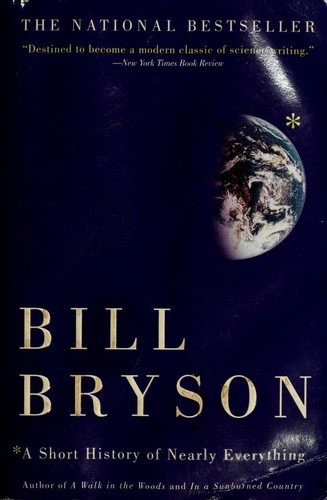
Talk to A Short History of Nearly Everything like its author wrote you back.
Get the ideas that fit your life — not generic summaries.
- Chat with the book
- Audiobook-style main ideas
- Adapts to your life and goals
- Helps you take action
A Short History of Nearly Everything, in detail
A Short History of Nearly Everything is Bill Bryson's attempt to understand the scientific story of everything — from the Big Bang to the emergence of modern humans — by spending three years talking to scientists and reading science history. The book's premise is simple: Bryson noticed that popular science writing explained what scientists had discovered but rarely explained how they had discovered it, who those people were, or what was at stake in the arguments. He set out to fix that.
The book moves through cosmology, physics, geology, chemistry, and biology, tracing not just the facts but the human stories behind them. The scientists who emerge are frequently eccentric, overlooked, or unjustly forgotten: Mary Anning, who discovered important Jurassic fossils on the Dorset coast but received little credit in her lifetime; Ignaz Semmelweis, who realized that doctors were killing patients by not washing their hands and was ridiculed for it; the geologists who spent decades fighting over how old the Earth actually was before radioactive dating settled the question. Bryson is especially good at conveying how many of the things we think of as settled science were, for long periods, contested or simply unknown.
Running through the book is a recurring sense of contingency and wonder. The universe had to exist, and matter had to form, and life had to emerge, and that life had to survive several extinction events, and a particular lineage had to evolve in a particular way over hundreds of millions of years, for humans to be here at all. Bryson does the math on these improbabilities throughout, and the cumulative effect is a sustained argument that existence itself is extraordinary.
The book covers a great deal of ground quickly, which means it sometimes simplifies. A few of its scientific claims have been updated since publication in 2003. But as a panoramic introduction to how science works and what it has found, it remains one of the most engaging books in the genre. Readers who finish it typically want to know more about nearly everything.
The big ideas
- 1.
Science advances through the work of specific, often overlooked, often eccentric individuals whose stories are as important as their discoveries.
- 2.
Most of what we know about the physical world was unknown or actively disputed within the last few hundred years. The pace of discovery is staggering.
- 3.
The Earth is roughly 4.5 billion years old — a figure that was bitterly contested until radiometric dating provided a reliable method in the early twentieth century.
