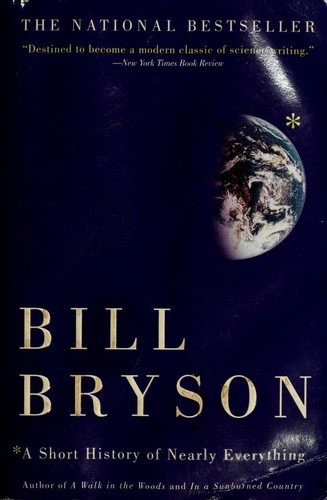
A Short History of Nearly Everything by Bill Bryson is a 2003 science book about scientific history, cosmology, evolution. Science advances through the work of specific, often overlooked, often eccentric individuals whose stories are as important as their discoveries.
Summary
A Short History of Nearly Everything is Bill Bryson's attempt to understand the scientific story of everything — from the Big Bang to the emergence of modern humans — by spending three years talking to scientists and reading science history. The book's premise is simple: Bryson noticed that popular science writing explained what scientists had discovered but rarely explained how they had discovered it, who those people were, or what was at stake in the arguments. He set out to fix that.
The book moves through cosmology, physics, geology, chemistry, and biology, tracing not just the facts but the human stories behind them. The scientists who emerge are frequently eccentric, overlooked, or unjustly forgotten: Mary Anning, who discovered important Jurassic fossils on the Dorset coast but received little credit in her lifetime; Ignaz Semmelweis, who realized that doctors were killing patients by not washing their hands and was ridiculed for it; the geologists who spent decades fighting over how old the Earth actually was before radioactive dating settled the question. Bryson is especially good at conveying how many of the things we think of as settled science were, for long periods, contested or simply unknown.
Running through the book is a recurring sense of contingency and wonder. The universe had to exist, and matter had to form, and life had to emerge, and that life had to survive several extinction events, and a particular lineage had to evolve in a particular way over hundreds of millions of years, for humans to be here at all. Bryson does the math on these improbabilities throughout, and the cumulative effect is a sustained argument that existence itself is extraordinary.
The book covers a great deal of ground quickly, which means it sometimes simplifies. A few of its scientific claims have been updated since publication in 2003. But as a panoramic introduction to how science works and what it has found, it remains one of the most engaging books in the genre. Readers who finish it typically want to know more about nearly everything.
Talk to A Short History of Nearly Everything like its author wrote you back.
Get the ideas that fit your life — not generic summaries.
- Chat with the book
- Audiobook-style main ideas
- Adapts to your life and goals
- Helps you take action
Key takeaways
- 1.
Science advances through the work of specific, often overlooked, often eccentric individuals whose stories are as important as their discoveries.
- 2.
Most of what we know about the physical world was unknown or actively disputed within the last few hundred years. The pace of discovery is staggering.
- 3.
The Earth is roughly 4.5 billion years old — a figure that was bitterly contested until radiometric dating provided a reliable method in the early twentieth century.
- 4.
Life's complexity depends on astonishing coincidences: the right distances from the right stars, the right elemental abundances, the right mass-extinction timing. Remove any one factor and humans don't exist.
- 5.
Plate tectonics — the idea that continents move — was dismissed as fringe science for decades before the evidence for seafloor spreading became undeniable in the 1960s.
- 6.
Many pivotal scientific contributions were made by people working outside the mainstream, including amateurs, women excluded from official institutions, and researchers in peripheral countries.
- 7.
The atom is mostly empty space. If the nucleus of a hydrogen atom were the size of a marble, its electron would orbit a kilometer away. Solidity is an emergent illusion.
- 8.
Extinction has been the norm, not the exception: roughly 99.9% of all species that have ever lived are now extinct, and several mass-extinction events nearly wiped out complex life entirely.
Discussion questions
Use these on your own, with a book club, or as chat starters in Superbook. Book club version, ready to copy or print →
- 1.
Bryson argues that science history is full of overlooked and undervalued contributors. Who do you think deserves more credit than they've received in fields you know?
- 2.
The book emphasizes how recently many things were unknown or disputed. Does that make you more or less confident in current scientific consensus?
- 3.
What's the most surprising thing you learned from the book, or the claim that most challenged a prior assumption?
- 4.
Bryson tells science as a human story, full of personality and conflict. Does humanizing scientists help or undermine the idea that science produces objective knowledge?
- 5.
The plate tectonics story shows how a correct theory can be resisted for decades. What does that suggest about how the scientific community should handle heterodox ideas?
- 6.
Bryson calculates the improbability of your own existence across cosmic time. Did that calculation change how you think about ordinary life?
- 7.
The book covers geology, physics, chemistry, and biology in a single volume. Which field did you find most surprising or unfamiliar?
- 8.
Semmelweis was ridiculed for telling doctors to wash their hands. What present-day equivalents might history judge harshly in fifty years?
- 9.
Bryson is a travel writer, not a scientist. Does his outsider perspective make the book more or less authoritative?
- 10.
How does the timescale of the universe — 13.8 billion years — change how you think about human history, which covers roughly 200,000 years at most?
- 11.
The book ends with concern about how humans are affecting Earth's biosphere. Does that concern feel earned after everything you've read, or does it feel tacked on?
- 12.
If you could go back and witness one moment in the history of scientific discovery Bryson describes, which would it be?
Themes
Frequently asked questions
-
Is A Short History of Nearly Everything accurate?
Broadly yes, though some specific claims have been updated since the 2003 publication. Bryson worked with scientists to check the manuscript and the book is well-sourced. A few numbers and findings have since been revised, but the overall picture holds.
-
How long is A Short History of Nearly Everything?
The main text runs to about 500 pages and takes most readers 10–12 hours. The paperback edition includes an extensive bibliography and notes. It is long but reads quickly because Bryson writes at pace and the chapters are structured as stories rather than lectures.
-
What level of science background do I need?
None. Bryson explicitly wrote the book as someone who knew very little and wanted to learn. He explains all the concepts from scratch. Readers with more science background may find some sections elementary but most appreciate the historical framing that technical texts omit.
-
Is it still worth reading given it was published in 2003?
Yes. The historical and geological sections are essentially unchanged, and the core science of cosmology, evolution, and chemistry remains accurate. A few specific numbers have been updated by subsequent research. The book's strength is its narrative and historical perspective, not cutting-edge findings.
-
Who should read it?
Anyone who wants a panoramic, human-centered view of how science discovered what it knows. Particularly good for people who struggled with science in school and want a way back in, or readers who want context for news about climate, space, or evolution.