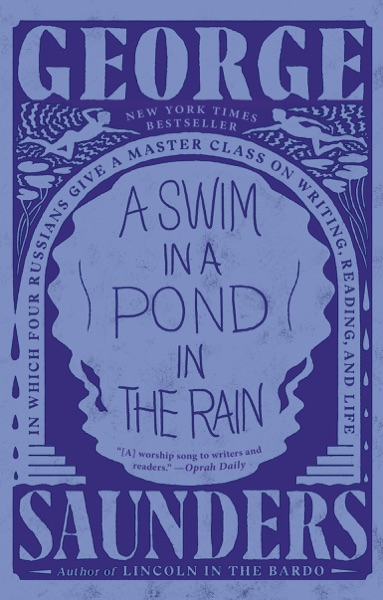
Talk to A Swim in a Pond in the Rain like its author wrote you back.
Get the ideas that fit your life — not generic summaries.
- Chat with the book
- Audiobook-style main ideas
- Adapts to your life and goals
- Helps you take action
What it argues
A Swim in a Pond in the Rain is George Saunders's account of the graduate fiction workshop he has taught at Syracuse for over twenty years, organized around seven stories by Tolstoy, Chekhov, Turgenev, and Gogol. The conceit is simple and effective: Saunders gives you a story in full, then walks through it section by section, asking what the story is doing at each moment and why it works. The result is one of the most practically useful books about fiction writing published in years.
Saunders's core pedagogical tool is what he calls the "Prussian officer test": read a story paragraph by paragraph and ask, at each moment, whether you would keep reading. If the answer is no, there is a problem to diagnose. The diagnosis usually comes down to a handful of things — the story hasn't established sufficient escalation, the prose has lost energy, the reader no longer cares about the outcome. Rather than offering a theory of fiction, Saunders treats the question empirically: what actually makes readers want to continue?
What it gets right
- 1.
Stories work when each moment creates sufficient curiosity to keep the reader moving. The Prussian officer test — would you keep reading here? — is more useful than any formal theory.
- 2.
Escalation is not about plot alone. Energy, diction, and even sentence rhythm can escalate. When a story stalls, something has leveled off that should still be rising.
- 3.
Russian literature of the nineteenth century is unusually instructive for writers today because these writers compressed enormous moral and social observation into short forms with relentless efficiency.
What it covers
Who wrote it
George Saunders is an American fiction writer and essayist, the author of the story collections CivilWarLand in Bad Decline, Pastoralia, In Persuasion Nation, and Tenth of December, as well as the novel Lincoln in the Bardo, which won the Man Booker Prize in 2017. He has taught in the MFA program at Syracuse University since 1996. He has been a frequent contributor to The New Yorker and was named a MacArthur Fellow in 2006. A Swim in a Pond in the Rain draws directly on materials he developed for his graduate fiction workshop.
