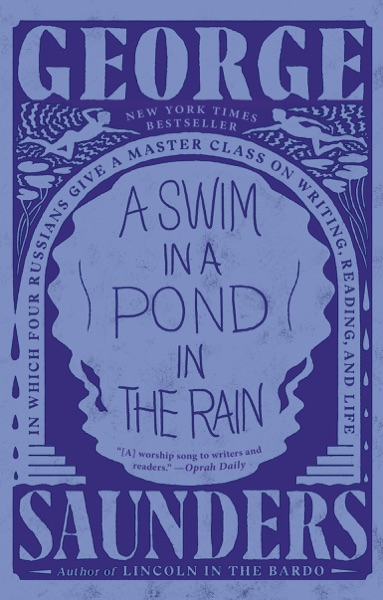
A Swim in a Pond in the Rain by George Saunders is a 2021 philosophy book about craft, fiction writing, russian literature. Stories work when each moment creates sufficient curiosity to keep the reader moving. The Prussian officer test — would you keep reading here? — is more useful than any formal theory.
Summary
A Swim in a Pond in the Rain is George Saunders's account of the graduate fiction workshop he has taught at Syracuse for over twenty years, organized around seven stories by Tolstoy, Chekhov, Turgenev, and Gogol. The conceit is simple and effective: Saunders gives you a story in full, then walks through it section by section, asking what the story is doing at each moment and why it works. The result is one of the most practically useful books about fiction writing published in years.
Saunders's core pedagogical tool is what he calls the "Prussian officer test": read a story paragraph by paragraph and ask, at each moment, whether you would keep reading. If the answer is no, there is a problem to diagnose. The diagnosis usually comes down to a handful of things — the story hasn't established sufficient escalation, the prose has lost energy, the reader no longer cares about the outcome. Rather than offering a theory of fiction, Saunders treats the question empirically: what actually makes readers want to continue?
The Russian stories provide ideal material because they are formally varied and technically precise. Chekhov's "In the Cart" and "The Darling" demonstrate the economy of implication — how much a story can do by what it withholds rather than states. Tolstoy's "Alyosha the Pot" shows how a saint's life can be rendered without sentimentality. Gogol's "The Nose" uses absurdity to expose how earnestly status-obsessed Russian bureaucracy was. Saunders reads all of them with a craftsman's eye, not a literary critic's.
The book is honest about its limitations. Saunders does not claim to explain what fiction is or why it matters philosophically. He stays at the level of what he has found to work in twenty years of teaching, which is exactly where most craft advice refuses to go. Writers at any level — beginning or experienced — will find something in the pages about escalation, character consistency, and the peculiar freedom that comes from writing badly on purpose in order to discover what the story actually needs.
Talk to A Swim in a Pond in the Rain like its author wrote you back.
Get the ideas that fit your life — not generic summaries.
- Chat with the book
- Audiobook-style main ideas
- Adapts to your life and goals
- Helps you take action
Key takeaways
- 1.
Stories work when each moment creates sufficient curiosity to keep the reader moving. The Prussian officer test — would you keep reading here? — is more useful than any formal theory.
- 2.
Escalation is not about plot alone. Energy, diction, and even sentence rhythm can escalate. When a story stalls, something has leveled off that should still be rising.
- 3.
Russian literature of the nineteenth century is unusually instructive for writers today because these writers compressed enormous moral and social observation into short forms with relentless efficiency.
- 4.
Chekhov's method of implication — stating less than the story knows — creates the reader's productive uncertainty that good fiction requires. The story doesn't explain; it shows and trusts the reader.
- 5.
Character consistency under pressure is what makes fictional people feel real. A character is a set of responses we have come to expect, and the story tests whether those responses hold when stakes rise.
- 6.
The first draft's job is to discover what the story is about, not to execute a plan. Saunders calls this writing badly in order to eventually write well — the discovery only happens in the mess.
- 7.
Form is inseparable from content in good fiction. The shape of a story — how it begins, what it includes, when it ends — is itself part of what the story means.
- 8.
Reading as a writer means maintaining dual consciousness: following the story as a reader and watching the technical moves as a student of craft, simultaneously.
Discussion questions
Use these on your own, with a book club, or as chat starters in Superbook. Book club version, ready to copy or print →
- 1.
Saunders structures the book around stories he teaches, not the ones he considers objectively greatest. What stories would you organize a writing class around, and what would that choice reveal about your values as a reader?
- 2.
The Prussian officer test assumes you can identify the moment a story loses you. Have you found that your own threshold for continuing is consistent, or does it vary unpredictably?
- 3.
Saunders argues that fiction works on the reader below the level of conscious thought. What's the last story that affected you in a way you couldn't fully explain?
- 4.
Chekhov withholds explanation and trusts the reader. Where in your own writing or communication do you over-explain rather than trust the reader or listener?
- 5.
Saunders says first drafts are for discovering what the story is about. Does that change how you think about starting any kind of creative or intellectual project, not just fiction?
- 6.
Gogol's absurdism in 'The Nose' reveals social anxieties more vividly than realism could. What contemporary anxieties do you think would best be exposed through absurdist rather than realistic treatment?
- 7.
He argues that the Russian writers were responding to enormous cultural pressures — censorship, serfdom, the collapse of traditional authority. How do those pressures shape what the stories could and couldn't say directly?
- 8.
What's the difference between reading as a reader and reading as a writer? Have you ever read the same book in both modes, and what changed?
- 9.
Saunders is honest that his pedagogy is empirical, not theoretical — this is what has worked in my classroom. Do you trust that kind of authority, or do you want a more principled foundation?
- 10.
The book is partly an argument that great stories produce ethical understanding without being didactic. Do you believe literature can actually change how people behave?
- 11.
Which of the seven Russian stories discussed in the book do you most want to read or re-read, based on Saunders's description? What drew you to it?
- 12.
He suggests that reading widely is less useful than reading one good story repeatedly until you fully understand what it's doing. Do you agree?
Themes
Frequently asked questions
-
Is A Swim in a Pond in the Rain worth reading?
Yes, especially for fiction writers or anyone who wants to read short stories more closely. It is one of the rare writing books that actually demonstrates craft instead of just describing it, and the Russian stories it works through are worth reading on their own.
-
Do I need to read the Russian stories before reading the book?
No. Saunders includes the full texts of all seven stories in the book. You read each story first, then work through his analysis. Having prior familiarity helps but is not required.
-
What is this book about?
It is a craft book built around seven nineteenth-century Russian short stories, using them to teach what makes fiction work at the sentence, paragraph, and structural level. It is also a book about why stories matter and what they do to readers that other forms of communication cannot.
-
Who should read this book?
Fiction writers at any level, teachers of writing, and serious readers who want to understand craft from the inside. Non-writers who love Russian literature and want a deeper way into Chekhov, Tolstoy, and Gogol will also find it rewarding.
-
What's the most useful idea in the book?
The Prussian officer test — stopping at each paragraph and asking whether the story has given you enough to keep reading. It turns an abstract question about quality into a concrete, repeatable diagnostic.