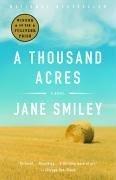
Talk to A Thousand Acres like its author wrote you back.
Get the ideas that fit your life — not generic summaries.
- Chat with the book
- Audiobook-style main ideas
- Adapts to your life and goals
- Helps you take action
What it argues
A Thousand Acres retells King Lear on a thousand-acre Iowa farm in the 1970s. Larry Cook is the patriarch — proud, respected, prosperous — who decides to divide his farm among his three daughters. Ginny and Rose, the two eldest, seem to welcome the plan; Caroline, the youngest, hesitates and is cut out. What follows is a story of family disintegration, told from Ginny's perspective, that gradually reveals the reason why Caroline's caution felt threatening to her father and why the two older sisters' acquiescence was not the simple loyalty it appeared to be.
What Smiley does that Shakespeare could not is give the daughters voices and interiority. Cordelia in King Lear is a symbol; Caroline here remains relatively opaque, but Ginny is fully realized — a woman who has learned to make herself invisible, to manage her husband's silences, to find meaning in work and accommodation. The novel's reworking of the Lear material is not allegorical decoration; Smiley uses the structure to ask what the original play looks like when you can see from the daughters' side, and the answer is disturbing.
What it gets right
- 1.
Smiley's central achievement is making visible what Shakespeare's play hides — the daughters' experience — and what she reveals implicates the original tragedy's sympathies.
- 2.
Ginny's narrative voice is one of accommodation and suppression: she tells us what she sees but withholds what she knows for most of the novel, and the reader gradually understands the shape of what is being kept back.
- 3.
The Iowa farm is both specific setting and symbol: the land represents patriarchal power and its inheritance, and the novel shows how working it is also how you are worked by it.
What it covers
Who wrote it
Jane Smiley is an American novelist born in Los Angeles in 1949 and raised in the Midwest. She is the author of more than twenty works of fiction and nonfiction, including the novels The Greenlanders (1988), Moo (1995), Horse Heaven (2000), and the Last Hundred Years trilogy (2014–2015). A Thousand Acres (1991) won the Pulitzer Prize for Fiction and the National Book Critics Circle Award. She is a member of the American Academy of Arts and Letters and taught for many years at Iowa State University.
