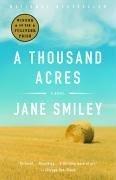
A Thousand Acres by Jane Smiley is a 1991 literary fiction book about land and inheritance, family silence and secrets, female experience and abuse. Smiley's central achievement is making visible what Shakespeare's play hides — the daughters' experience — and what she reveals implicates the original tragedy's sympathies.
Summary
A Thousand Acres retells King Lear on a thousand-acre Iowa farm in the 1970s. Larry Cook is the patriarch — proud, respected, prosperous — who decides to divide his farm among his three daughters. Ginny and Rose, the two eldest, seem to welcome the plan; Caroline, the youngest, hesitates and is cut out. What follows is a story of family disintegration, told from Ginny's perspective, that gradually reveals the reason why Caroline's caution felt threatening to her father and why the two older sisters' acquiescence was not the simple loyalty it appeared to be.
What Smiley does that Shakespeare could not is give the daughters voices and interiority. Cordelia in King Lear is a symbol; Caroline here remains relatively opaque, but Ginny is fully realized — a woman who has learned to make herself invisible, to manage her husband's silences, to find meaning in work and accommodation. The novel's reworking of the Lear material is not allegorical decoration; Smiley uses the structure to ask what the original play looks like when you can see from the daughters' side, and the answer is disturbing.
Smiley is a Midwesterner writing about the Midwest with authority — the soil, the farming, the seasons, the specific texture of Iowa agricultural life in the moment when family farms were beginning to fail under pressure from industrial agriculture and debt. That economic backdrop gives the novel a historical weight that lifts it beyond domestic drama. The land is not just property; it is identity, history, and the thing around which every relationship in the novel is organized.
A Thousand Acres won the Pulitzer Prize and the National Book Critics Circle Award in 1992. It is a demanding read — dark, unhurried, and without the consolations of the tragedy it rewrites. Lear ends with a kind of cosmic sorrow; Smiley ends with something smaller and more accurate: the particular exhaustion of women who have survived things they were not supposed to name.
Talk to A Thousand Acres like its author wrote you back.
Get the ideas that fit your life — not generic summaries.
- Chat with the book
- Audiobook-style main ideas
- Adapts to your life and goals
- Helps you take action
Key takeaways
- 1.
Smiley's central achievement is making visible what Shakespeare's play hides — the daughters' experience — and what she reveals implicates the original tragedy's sympathies.
- 2.
Ginny's narrative voice is one of accommodation and suppression: she tells us what she sees but withholds what she knows for most of the novel, and the reader gradually understands the shape of what is being kept back.
- 3.
The Iowa farm is both specific setting and symbol: the land represents patriarchal power and its inheritance, and the novel shows how working it is also how you are worked by it.
- 4.
Rose is the angrier and more articulate of the two older daughters, but the novel does not make her a simple truth-teller; her anger has its own blindnesses.
- 5.
The novel's treatment of abuse is not sensationalized — it arrives as something ordinary and long-standing, which is both more realistic and more disturbing than dramatic revelation.
- 6.
The economic decline of the family farm intersects with the personal decline of the Cook family: the novel refuses to separate the social from the intimate.
- 7.
Caroline's behavior — the youngest daughter who seems to choose the father over the sisters — makes more sense in the novel's terms than Cordelia's virtue does in Lear's.
- 8.
The ending withholds redemption. Ginny survives; she does not triumph, reconcile, or arrive at peace. The novel thinks that is the honest version of this story.
Discussion questions
Use these on your own, with a book club, or as chat starters in Superbook. Book club version, ready to copy or print →
- 1.
The novel inverts King Lear's sympathies by giving us Ginny's perspective. Did that inversion work for you, or did you resist it?
- 2.
You don't need to have read King Lear to read this novel — but does knowing the source material change your reading? In what ways?
- 3.
Ginny accommodates, suppresses, and continues for most of the novel. Is she a sympathetic protagonist? Does that question even make sense for this kind of story?
- 4.
Rose knows things that Ginny has buried. How does the novel handle the difference between a woman who remembers and a woman who does not?
- 5.
Larry Cook is monstrous, but the novel gives him moments of recognizable humanity. Does Smiley ask you to understand him?
- 6.
The novel is set at a specific moment in Iowa agriculture — when debt and industrial farming were destroying family farms. How much does that economic context matter to your reading?
- 7.
Caroline sides with her father. How do you understand her choice? Is she naive, strategic, in denial, or something else?
- 8.
The abuse in the novel is revealed gradually rather than announced. How did you respond to that structure? Did it feel manipulative or realistic?
- 9.
The land is the central object in the novel — more fought over than love or money. What does land mean in the world Smiley is describing?
- 10.
Smiley won the Pulitzer for this novel the same year that Cormac McCarthy's All the Pretty Horses was considered the favorite. The choice was controversial. Do you think A Thousand Acres is a Pulitzer-worthy novel?
- 11.
The ending offers survival without resolution. Is that a satisfying ending for this kind of story?
- 12.
If you read King Lear after finishing this novel, do you think you would read it differently? In what ways?
Themes
Frequently asked questions
-
Do I need to have read King Lear to read A Thousand Acres?
No. The novel works as a standalone story of a farming family's disintegration. But knowing the Lear material enriches it significantly: you see what Smiley is doing with the structure, and the reversals of sympathy are sharper when you have the original in mind.
-
Is A Thousand Acres worth reading?
Yes, if you're drawn to literary fiction about family, abuse, and female interiority told without consolation. It is demanding and dark, but Smiley's prose is controlled and the Iowa setting is rendered with real authority. It is not a comfortable read.
-
What is A Thousand Acres about, without spoilers?
An Iowa patriarch divides his farm among his three daughters, triggering a family collapse that retells King Lear from the daughters' perspective. The novel gradually reveals the history of abuse that explains why the daughters respond as they do, and what survival looks like for women in that world.
-
Is there a film adaptation?
Yes. A 1997 film starring Jessica Lange, Michelle Pfeiffer, and Jason Robards was released, directed by Jocelyn Moorhouse. It received mixed reviews and is considered inferior to the novel, though the performances are noteworthy.
-
Who shouldn't read A Thousand Acres?
Readers who need forward momentum, resolution, or redemption. The novel is a tragedy without the aesthetic distance that Shakespeare's structure provides — it ends in quiet devastation. Readers sensitive to detailed treatment of sexual abuse within families should also be aware that this content is central.
-
Why is A Thousand Acres considered important?
It was one of the first major American novels to systematically rewrite a classic from the perspective of the female characters who had been secondary or symbolic in the original — and to find, from that perspective, something the original could not see. It was part of a broader shift in literary fiction toward taking women's experience seriously as the primary subject.