Talk to A Wealth of Common Sense like its author wrote you back.
Get the ideas that fit your life — not generic summaries.
- Chat with the book
- Audiobook-style main ideas
- Adapts to your life and goals
- Helps you take action
A Wealth of Common Sense, in detail
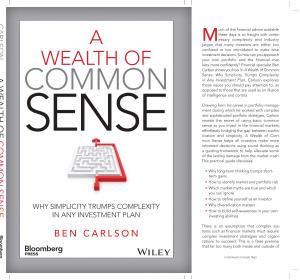
A Wealth of Common Sense is Ben Carlson's argument that individual investors outperform most professionals not by being smarter but by doing fewer things and making fewer mistakes. Carlson is a portfolio manager and writer who runs the blog A Wealth of Common Sense, and the book draws on both his professional experience and a close reading of the behavioral finance literature. The core claim is that simple, low-cost, diversified strategies outperform complex ones over long periods — not because the strategies are optimal in every market environment, but because they are sustainable and require almost no behavioral discipline to execute.
Carlson spends considerable time on the gap between what investors know and what they do. Most financially literate people know they should buy low and sell high, diversify, hold through volatility, and keep costs down. Most of them don't do it consistently. The reasons are psychological: loss aversion, recency bias, the narrative fallacy that makes recent market performance feel like evidence about the future, and the illusion that more sophisticated analysis leads to better outcomes. The book documents these biases clearly and offers a framework for designing a portfolio that's robust to them.
The practical recommendations center on simplicity: a small number of broad asset classes, index funds, automatic rebalancing, and predetermined rules for reacting to downturns. Carlson is direct about what this approach gives up — it won't beat the market in any given year, it won't feel interesting, and it will look embarrassing during periods when alternative strategies are working. What it provides is low costs, behavioral sustainability, and a return profile that compounds reliably over decades.
The most useful sections deal with how to handle market volatility, which is when most investors make expensive mistakes. Carlson argues that having a written investment policy statement — a document specifying your asset allocation, rebalancing rules, and how you will respond to various market scenarios — is the single most protective tool available to individual investors. The discipline of articulating your strategy in advance removes the worst decisions from emotional real-time processing.
The big ideas
- 1.
Simplicity beats complexity in investing over long periods. A three-fund portfolio beats most actively managed alternatives not because it's optimized but because it's sustainable and cheap.
- 2.
The gap between investment returns and investor returns is large and persistent. Most investors underperform their own funds by timing poorly — buying after gains and selling after losses.
- 3.
Costs compound just like returns. A 1% annual fee that seems trivial can absorb 20–25% of terminal wealth over a thirty-year period.
