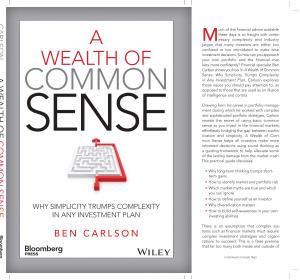
A Wealth of Common Sense by Ben Carlson is a 2015 economics book about portfolio management, behavioral finance, long-term investing. Simplicity beats complexity in investing over long periods. A three-fund portfolio beats most actively managed alternatives not because it's optimized but because it's sustainable and cheap.
Summary
A Wealth of Common Sense is Ben Carlson's argument that individual investors outperform most professionals not by being smarter but by doing fewer things and making fewer mistakes. Carlson is a portfolio manager and writer who runs the blog A Wealth of Common Sense, and the book draws on both his professional experience and a close reading of the behavioral finance literature. The core claim is that simple, low-cost, diversified strategies outperform complex ones over long periods — not because the strategies are optimal in every market environment, but because they are sustainable and require almost no behavioral discipline to execute.
Carlson spends considerable time on the gap between what investors know and what they do. Most financially literate people know they should buy low and sell high, diversify, hold through volatility, and keep costs down. Most of them don't do it consistently. The reasons are psychological: loss aversion, recency bias, the narrative fallacy that makes recent market performance feel like evidence about the future, and the illusion that more sophisticated analysis leads to better outcomes. The book documents these biases clearly and offers a framework for designing a portfolio that's robust to them.
The practical recommendations center on simplicity: a small number of broad asset classes, index funds, automatic rebalancing, and predetermined rules for reacting to downturns. Carlson is direct about what this approach gives up — it won't beat the market in any given year, it won't feel interesting, and it will look embarrassing during periods when alternative strategies are working. What it provides is low costs, behavioral sustainability, and a return profile that compounds reliably over decades.
The most useful sections deal with how to handle market volatility, which is when most investors make expensive mistakes. Carlson argues that having a written investment policy statement — a document specifying your asset allocation, rebalancing rules, and how you will respond to various market scenarios — is the single most protective tool available to individual investors. The discipline of articulating your strategy in advance removes the worst decisions from emotional real-time processing.
Talk to A Wealth of Common Sense like its author wrote you back.
Get the ideas that fit your life — not generic summaries.
- Chat with the book
- Audiobook-style main ideas
- Adapts to your life and goals
- Helps you take action
Key takeaways
- 1.
Simplicity beats complexity in investing over long periods. A three-fund portfolio beats most actively managed alternatives not because it's optimized but because it's sustainable and cheap.
- 2.
The gap between investment returns and investor returns is large and persistent. Most investors underperform their own funds by timing poorly — buying after gains and selling after losses.
- 3.
Costs compound just like returns. A 1% annual fee that seems trivial can absorb 20–25% of terminal wealth over a thirty-year period.
- 4.
An investment policy statement — a written document specifying your allocation, rebalancing rules, and crisis response plan — removes the worst decisions from emotional in-the-moment processing.
- 5.
Diversification doesn't maximize returns in any given period. Its purpose is to reduce the magnitude of mistakes, which is what actually determines long-run outcomes.
- 6.
Market timing requires being right twice — once going out and once going back in. The evidence that anyone does this consistently is weak; the evidence that most people do it badly is overwhelming.
- 7.
Rebalancing has modest return benefits but large behavioral benefits. It forces you to buy what's recently declined and sell what's recently risen, which is the direction you know you should trade but usually don't.
- 8.
The best investment strategy for most people is one they can actually stick to across a full market cycle, including a prolonged drawdown. Theoretical optimality that can't be executed is worthless.
Discussion questions
Use these on your own, with a book club, or as chat starters in Superbook. Book club version, ready to copy or print →
- 1.
Carlson argues that investors' biggest enemy is their own behavior. What is the most expensive investing mistake you've personally made, and what drove it?
- 2.
He advocates a written investment policy statement. Have you written one? If not, what has stopped you — and what would happen if you did it this week?
- 3.
The book distinguishes between what you know and what you do. Where in your financial life is the gap between knowledge and action largest?
- 4.
Carlson says simplicity beats complexity for most investors. What sophisticated investment strategies have you been tempted by that in retrospect you're glad you avoided — or wish you had avoided?
- 5.
How do you typically respond to a significant market drop — say, 20% in a month? What would you actually do versus what you know you should do?
- 6.
The 1% fee example shows costs eroding terminal wealth significantly. What are the actual total costs on your current investment accounts?
- 7.
Rebalancing forces you to sell high and buy low mechanically. Have you ever rebalanced into a downturn? How did it feel?
- 8.
Carlson notes that an interesting portfolio — one you have strong views on and enjoy thinking about — is often a more expensive portfolio. How much does the entertainment value of investing cost you?
- 9.
Who in your life has the best long-term investment track record? How much of that do you attribute to strategy versus behavior versus luck?
- 10.
The book argues diversification's primary purpose is error reduction, not return maximization. Does that framing change how you think about your own diversification?
- 11.
If your entire financial life were simplified to three decisions — asset allocation, savings rate, and cost control — which of the three would you most need to improve?
Themes
Frequently asked questions
-
Is A Wealth of Common Sense worth reading if I've already read The Little Book of Common Sense Investing?
Yes. Carlson covers similar ground on index investing but goes further on the behavioral dimension — why people don't stick to simple strategies even when they know the evidence — and on practical portfolio mechanics like rebalancing and investment policy statements.
-
How long does it take to read?
Around three to four hours. It's a quick read and the chapters are self-contained. The behavioral sections reward a second pass once you've finished and can see the full argument.
-
What is Carlson's core investment philosophy?
Use low-cost broad index funds across a small number of asset classes, rebalance on a predetermined schedule, keep costs minimal, and write down your strategy in advance so you don't make emotional decisions during downturns.
-
Who should read this book?
Anyone who has investment accounts but hasn't been satisfied with their own behavior — either the frequency of changes, the costs they're paying, or their reaction to market volatility. Also useful for people who know what to do but aren't doing it.
-
What is the most actionable idea in this book?
Write an investment policy statement before the next market crisis. Specify your target allocation, your rebalancing trigger, and how you will respond to a 20%, 30%, and 40% drawdown. Commit to it in writing. This is the cheapest and most durable behavioral protection available.
Similar books
The Little Book of Common Sense Investing
John C. Bogle
A Random Walk Down Wall Street
Burton G. Malkiel
The Psychology of Money
Morgan Housel
The Bogleheads' Guide to Investing
Taylor Larimore
