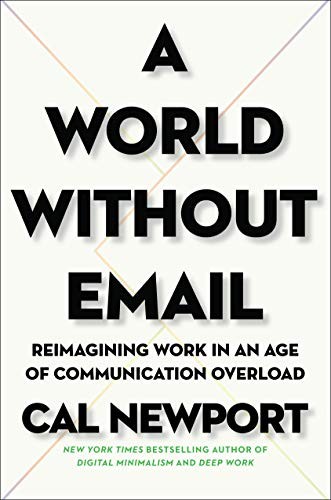
Talk to A World Without Email like its author wrote you back.
Get the ideas that fit your life — not generic summaries.
- Chat with the book
- Audiobook-style main ideas
- Adapts to your life and goals
- Helps you take action
A World Without Email, in detail
A World Without Email is Cal Newport's most targeted critique of modern knowledge work culture. Where Deep Work argued that focused concentration is valuable and worth protecting, this book argues that the specific communication protocol most offices run on — what Newport calls the "hyperactive hive mind," characterized by constant email and messaging availability — is not inevitable and is actively destroying the conditions needed for serious work. The title is deliberately provocative; the book is less about eliminating email than about replacing the haphazard, always-on communication culture it has enabled.
Newport's diagnosis is economic and structural rather than personal. The hyperactive hive mind emerged not because anyone designed it but because knowledge workers adopting email in the 1990s defaulted to a pattern of informal, unstructured communication that was individually rational in the short term. Sending a quick message felt more efficient than scheduling a meeting or documenting a process. Over time this created a kind of coordination debt: the accumulated need for ongoing check-ins that now consumes most of a knowledge worker's day.
The second half of the book is prescriptive. Newport proposes a "process-centric" approach to collaboration, where workflows are designed explicitly so that most coordination happens through structured systems — project management tools, clear protocols, scheduled check-ins — rather than ad hoc messages. He profiles several organizations that have moved in this direction: law firms, software companies, and academic departments that have reduced unstructured messaging significantly and seen productivity and morale improve.
Newport's prescriptions are easier to adopt for managers and team leaders than for individual contributors who can't unilaterally change how their organization communicates. He acknowledges this tension without fully resolving it. The book is strongest as a diagnostic: it gives knowledge workers precise language for a problem they sense but haven't been able to name clearly, and makes a credible case that the current default is not the only way.
The big ideas
- 1.
The 'hyperactive hive mind' — constant availability on email and messaging apps — emerged accidentally, not by design, and has become the default knowledge work protocol despite no evidence it is optimal.
- 2.
Context switching is the hidden cost. Every time a worker shifts attention to respond to a message, the original task suffers from attention residue that can last 20 minutes or more.
- 3.
Most knowledge workers now spend the majority of their workday on communication overhead, leaving little time for the focused work that actually creates value.
