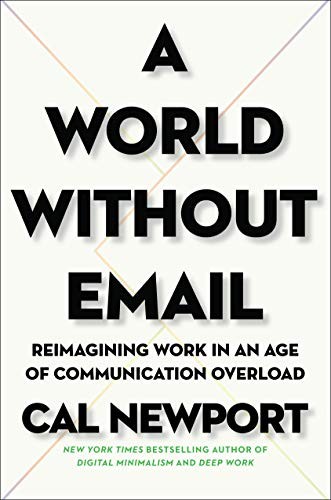
A World Without Email by Cal Newport is a 2021 business book about email, productivity, knowledge work. The 'hyperactive hive mind' — constant availability on email and messaging apps — emerged accidentally, not by design, and has become the default knowledge work protocol despite no evidence it is optimal.
Summary
A World Without Email is Cal Newport's most targeted critique of modern knowledge work culture. Where Deep Work argued that focused concentration is valuable and worth protecting, this book argues that the specific communication protocol most offices run on — what Newport calls the "hyperactive hive mind," characterized by constant email and messaging availability — is not inevitable and is actively destroying the conditions needed for serious work. The title is deliberately provocative; the book is less about eliminating email than about replacing the haphazard, always-on communication culture it has enabled.
Newport's diagnosis is economic and structural rather than personal. The hyperactive hive mind emerged not because anyone designed it but because knowledge workers adopting email in the 1990s defaulted to a pattern of informal, unstructured communication that was individually rational in the short term. Sending a quick message felt more efficient than scheduling a meeting or documenting a process. Over time this created a kind of coordination debt: the accumulated need for ongoing check-ins that now consumes most of a knowledge worker's day.
The second half of the book is prescriptive. Newport proposes a "process-centric" approach to collaboration, where workflows are designed explicitly so that most coordination happens through structured systems — project management tools, clear protocols, scheduled check-ins — rather than ad hoc messages. He profiles several organizations that have moved in this direction: law firms, software companies, and academic departments that have reduced unstructured messaging significantly and seen productivity and morale improve.
Newport's prescriptions are easier to adopt for managers and team leaders than for individual contributors who can't unilaterally change how their organization communicates. He acknowledges this tension without fully resolving it. The book is strongest as a diagnostic: it gives knowledge workers precise language for a problem they sense but haven't been able to name clearly, and makes a credible case that the current default is not the only way.
Talk to A World Without Email like its author wrote you back.
Get the ideas that fit your life — not generic summaries.
- Chat with the book
- Audiobook-style main ideas
- Adapts to your life and goals
- Helps you take action
Key takeaways
- 1.
The 'hyperactive hive mind' — constant availability on email and messaging apps — emerged accidentally, not by design, and has become the default knowledge work protocol despite no evidence it is optimal.
- 2.
Context switching is the hidden cost. Every time a worker shifts attention to respond to a message, the original task suffers from attention residue that can last 20 minutes or more.
- 3.
Most knowledge workers now spend the majority of their workday on communication overhead, leaving little time for the focused work that actually creates value.
- 4.
The solution is process design, not personal discipline. Workflows that specify who communicates what, how, and when reduce the coordination overhead that generates most inbox volume.
- 5.
Scheduled office hours, shared documents, and project management tools can replace most of the back-and-forth that currently clogs inboxes, without sacrificing responsiveness.
- 6.
The feeling of busyness generated by a full inbox is not the same as the feeling of doing meaningful work. The former can crowd out the latter entirely.
- 7.
Organizations that have moved toward structured collaboration protocols report higher productivity and lower employee stress, not just the reverse.
- 8.
Individual workers can reduce their email burden without organizational change by designing their own protocols: slow response norms, detailed first messages, and structured conversations.
Discussion questions
Use these on your own, with a book club, or as chat starters in Superbook. Book club version, ready to copy or print →
- 1.
Newport claims the hyperactive hive mind emerged by default rather than design. Does that match your experience of how communication norms at your organization developed?
- 2.
How many hours per day do you estimate you spend on email, Slack, or equivalent messaging? How does that compare to time spent on the actual outputs your work requires?
- 3.
What would change about your work if your response time to non-urgent messages was measured in hours rather than minutes?
- 4.
Newport argues that constant availability is culturally expected but not operationally necessary for most knowledge work. Do you agree? What would the exceptions be?
- 5.
Pick one recurring conversation in your inbox. Could it be replaced with a protocol, a shared document, or a weekly check-in? What would that require?
- 6.
Where in your work does the pressure to appear available conflict with your ability to do your best work?
- 7.
Newport profiles organizations that have reduced unstructured messaging. What would the biggest obstacle be at your organization to a similar change?
- 8.
What assumptions about responsiveness do you think your colleagues have about you? Are they accurate?
- 9.
Think of a project that involved a lot of back-and-forth communication. Could a clearer upfront structure have reduced that overhead without sacrificing quality?
- 10.
If you managed a team, what protocol changes would you implement first to reduce unnecessary messaging?
- 11.
Newport suggests that the hyperactive hive mind makes workers feel busy while eroding the conditions for deep work. Have you noticed this dynamic personally?
- 12.
What would you do with two additional hours of uninterrupted time each day if messaging overhead dropped?
Themes
Frequently asked questions
-
Is A World Without Email just a longer version of Deep Work?
No. Deep Work focuses on individual attention management. A World Without Email zooms out to the organizational level, arguing that individual deep work habits are insufficient when the underlying communication culture demands constant availability. The diagnosis and prescriptions are distinct, though complementary.
-
Do I need to read Deep Work first?
It helps but isn't required. Newport recaps the relevant ideas briefly. If you've read Deep Work, A World Without Email reads as the natural next question: okay, individual focus is valuable — how do you protect it when your organization runs on constant messaging?
-
Is this book only useful for managers?
No, though managers have more leverage to implement the protocols Newport recommends. Individual contributors can still apply the principles — slower response norms, structured first messages, designated focus periods — without organizational buy-in.
-
What does 'a world without email' actually mean?
Newport isn't literally advocating for eliminating email. The provocative title refers to a world without the culture of constant, unstructured messaging that email enabled. His prescriptions involve replacing that culture with intentional workflow design, not with silence.
-
How long does it take to read A World Without Email?
About four to five hours. The diagnostic first half is more engaging than the prescriptive second half, which can feel repetitive. The core argument can be absorbed in the first 100 pages; the rest builds the case with examples and detail.