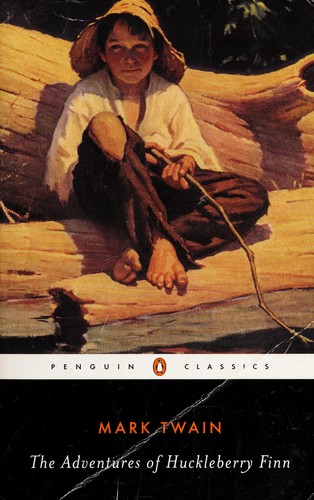
Talk to Adventures of Huckleberry Finn like its author wrote you back.
Get the ideas that fit your life — not generic summaries.
- Chat with the book
- Audiobook-style main ideas
- Adapts to your life and goals
- Helps you take action
Adventures of Huckleberry Finn, in detail
Adventures of Huckleberry Finn begins where Tom Sawyer left off — Huck Finn, the outcast son of the town drunk, has been taken in and given a respectable life he doesn't want. He fakes his own death to escape his abusive father, and sets out down the Mississippi River on a raft with Jim, an enslaved man fleeing his owner. What follows is part road novel, part moral education, and part devastating critique of American life — written by a man who had lived in the South before the Civil War and had thought hard about what he'd seen.
The novel's emotional center is the friendship between Huck and Jim, and the gradual, hard-won shift in Huck's understanding of Jim as a human being rather than property. The famous chapter in which Huck decides he would rather go to hell than turn Jim in — against everything his society, his church, and his upbringing have taught him — is one of the most remarkable acts of moral reasoning in American literature, precisely because Huck doesn't experience it as reasoning. He experiences it as failure, and does the right thing anyway.
Twain writes in Huck's dialect — unlettered, colloquial, acutely observed — and the voice is one of the great achievements of American prose. The comedy is sharp. The cruelty is sharper. The novel moves through a gallery of American types — con men, mob violence, feuding families, riverboat showmanship — and every scene doubles as satire. Hemingway's claim that all American literature descends from Huckleberry Finn is often quoted; it is also broadly defensible.
The novel has a serious problem: its ending. The last quarter, in which Tom Sawyer arrives and turns Jim's escape into an elaborate game, is widely regarded as a failure — unfunny, cruel in ways the earlier novel earns and this one doesn't, and deeply unsatisfying after the emotional honesty of what precedes it. Twain scholars have argued about it for a century. Read the book knowing the ending will disappoint you; the journey is still worth it.
The big ideas
- 1.
Huck's decision to help Jim escape is presented not as moral heroism but as moral failure — he believes he is doing wrong and does it anyway. That inversion of conventional conscience is the novel's most radical move.
- 2.
Jim is drawn with more interiority and dignity than almost any Black character in nineteenth-century American fiction, while the white characters around him are largely satirized or condemned.
- 3.
Twain's use of dialect is not a stylistic quirk — it's a political statement about whose voice gets to tell the story, and Huck's limited, honest perspective allows the reader to see things Huck himself can't quite name.
