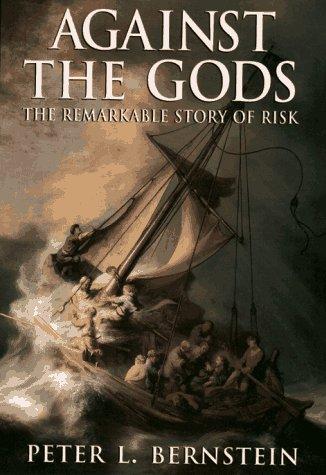
Talk to Against the Gods: The Remarkable Story of Risk like its author wrote you back.
Get the ideas that fit your life — not generic summaries.
- Chat with the book
- Audiobook-style main ideas
- Adapts to your life and goals
- Helps you take action
What it argues
Against the Gods is Peter Bernstein's intellectual history of how humanity learned to measure, quantify, and manage risk — a story he traces from ancient gambling in the Mediterranean through the development of modern probability theory, statistics, and financial derivatives. The title comes from Bernstein's argument that the development of risk management is the defining achievement of modernity: before the mathematical tools for calculating probability existed, the future was understood as fate, subject to divine will. After them, the future became a domain where humans could act strategically.
The book moves through centuries of intellectual history: the Renaissance gamblers and mathematicians (Cardano, Pascal, Fermat) who first formalized probability; the Enlightenment statisticians who applied it to demography and insurance; the early twentieth-century economists who tried to quantify uncertainty itself; and the postwar finance theorists (Markowitz, Sharpe, Black, Scholes) who built the modern toolkit for pricing and hedging risk. Bernstein is a financial historian first, and his explanations of portfolio theory, options pricing, and modern risk management are careful and accurate without being condescending.
What it gets right
- 1.
Risk management is historically recent. Before the 17th century, probability theory did not exist, and the future was understood as fate beyond human calculation.
- 2.
Pascal and Fermat's exchange about a gambling problem in 1654 is often cited as the birth of probability theory — the first systematic attempt to quantify uncertainty.
- 3.
The law of large numbers, developed by Bernoulli, showed that individual random events become predictable in aggregate. This underpins insurance, actuarial science, and modern statistics.
What it covers
Who wrote it
Peter L. Bernstein (1919–2009) was an American financial historian, economist, and investment consultant who spent his career at the intersection of academic finance and practical market experience. He founded Peter L. Bernstein Inc., an economic consulting firm, and was editor of the Journal of Portfolio Management for decades. Against the Gods, published in 1996, became a bestseller that reached well beyond finance professionals. His other major work, Capital Ideas (1992), covers the development of modern portfolio theory. He wrote and lectured on financial history until late in his life.
