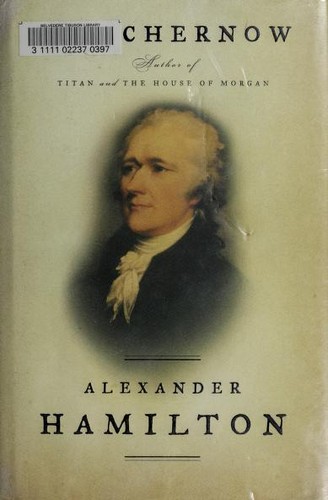
Talk to Alexander Hamilton like its author wrote you back.
Get the ideas that fit your life — not generic summaries.
- Chat with the book
- Audiobook-style main ideas
- Adapts to your life and goals
- Helps you take action
Alexander Hamilton, in detail
Ron Chernow's biography of Alexander Hamilton — immigrant, orphan, Revolutionary War aide-de-camp, first Secretary of the Treasury, founder of the American financial system, and victim of Aaron Burr's bullet — is the most comprehensive single-volume account of Hamilton's life and the book that most directly sparked the Hamilton revival in popular culture, including Lin-Manuel Miranda's musical. Published in 2004, it rehabilitated a founder who had been largely overshadowed by Washington, Jefferson, and Madison, and argued for his central importance to the America that actually exists.
Hamilton arrived in New York from the Caribbean with almost nothing — an illegitimate child born in Nevis, orphaned when his mother died of yellow fever, sent to America by benefactors who recognized his intelligence — and the ambition he developed in those circumstances never left him. Chernow traces the formation carefully: the Caribbean poverty, the self-education, the youthful newspaper polemics that showed a rhetorical gift, the military service under Washington during the Revolutionary War where he became the general's most trusted aide and eventually his surrogate son.
The political chapters are the biography's most important historical contribution. Hamilton's design of the American financial system — the national bank, assumption of state debts, a funded national debt, a customs service, a coast guard — was opposed by Jefferson and Madison on constitutional and political grounds, and the debate between them defined the first generation of American politics and many of the divisions that persist today. Chernow is sympathetic to Hamilton and argues that his financial innovations were foundational; Jeffersonian critics will find the balance imperfect.
The duel with Burr, which Hamilton knew was likely to kill him and which he walked into anyway, is the biography's most psychologically interesting episode. Chernow's explanation — that Hamilton believed declining the duel would have destroyed his political reputation and rendered all his public service meaningless — is plausible, but it also reveals something about Hamilton's relationship to honor and sacrifice that the biography traces back to the Caribbean orphan's need to prove himself repeatedly.
The big ideas
- 1.
Hamilton's financial architecture is the foundation of the American state. The national bank, funded debt, and customs revenue system he designed are so embedded in American institutional life that they are now invisible.
- 2.
The Hamilton-Jefferson rivalry defined the first generation of American politics. The disagreement was genuine and substantive — about the nature of the republic, the relationship between federal and state authority, and the role of commercial finance in a democracy.
- 3.
Ambition shaped by poverty and illegitimacy differs from ambition shaped by privilege. Hamilton's need to prove himself was not incidental to his achievements; it was the psychological engine.
