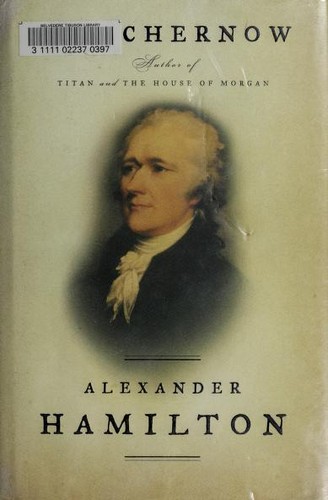
Alexander Hamilton by Ron Chernow is a 2004 biography book about founding fathers, finance, ambition. Hamilton's financial architecture is the foundation of the American state. The national bank, funded debt, and customs revenue system he designed are so embedded in American institutional life that they are now invisible.
Summary
Ron Chernow's biography of Alexander Hamilton — immigrant, orphan, Revolutionary War aide-de-camp, first Secretary of the Treasury, founder of the American financial system, and victim of Aaron Burr's bullet — is the most comprehensive single-volume account of Hamilton's life and the book that most directly sparked the Hamilton revival in popular culture, including Lin-Manuel Miranda's musical. Published in 2004, it rehabilitated a founder who had been largely overshadowed by Washington, Jefferson, and Madison, and argued for his central importance to the America that actually exists.
Hamilton arrived in New York from the Caribbean with almost nothing — an illegitimate child born in Nevis, orphaned when his mother died of yellow fever, sent to America by benefactors who recognized his intelligence — and the ambition he developed in those circumstances never left him. Chernow traces the formation carefully: the Caribbean poverty, the self-education, the youthful newspaper polemics that showed a rhetorical gift, the military service under Washington during the Revolutionary War where he became the general's most trusted aide and eventually his surrogate son.
The political chapters are the biography's most important historical contribution. Hamilton's design of the American financial system — the national bank, assumption of state debts, a funded national debt, a customs service, a coast guard — was opposed by Jefferson and Madison on constitutional and political grounds, and the debate between them defined the first generation of American politics and many of the divisions that persist today. Chernow is sympathetic to Hamilton and argues that his financial innovations were foundational; Jeffersonian critics will find the balance imperfect.
The duel with Burr, which Hamilton knew was likely to kill him and which he walked into anyway, is the biography's most psychologically interesting episode. Chernow's explanation — that Hamilton believed declining the duel would have destroyed his political reputation and rendered all his public service meaningless — is plausible, but it also reveals something about Hamilton's relationship to honor and sacrifice that the biography traces back to the Caribbean orphan's need to prove himself repeatedly.
Talk to Alexander Hamilton like its author wrote you back.
Get the ideas that fit your life — not generic summaries.
- Chat with the book
- Audiobook-style main ideas
- Adapts to your life and goals
- Helps you take action
Key takeaways
- 1.
Hamilton's financial architecture is the foundation of the American state. The national bank, funded debt, and customs revenue system he designed are so embedded in American institutional life that they are now invisible.
- 2.
The Hamilton-Jefferson rivalry defined the first generation of American politics. The disagreement was genuine and substantive — about the nature of the republic, the relationship between federal and state authority, and the role of commercial finance in a democracy.
- 3.
Ambition shaped by poverty and illegitimacy differs from ambition shaped by privilege. Hamilton's need to prove himself was not incidental to his achievements; it was the psychological engine.
- 4.
Hamilton foresaw that America's global role would require a strong federal government with financial credibility. Jefferson foresaw that such a government might become tyrannical. Both were right.
- 5.
The duel was not irrational. Hamilton understood the code of honor that governed elite male life in early America, and his decision to submit to it was consistent with that code even as it killed him.
- 6.
The Federalist Papers remain the most important explanation of the Constitution ever written. Hamilton wrote the majority of them under deadline pressure while managing other responsibilities.
- 7.
Hamilton's personal behavior — the Reynolds affair, his treatment of Burr — shows that his ethical standards in private life did not always match his public positions.
- 8.
Legacy is contested. Hamilton was largely forgotten for a century before Chernow's biography and the Miranda musical restored him to public attention. The reasons for that forgetting — Jefferson's grip on the American national narrative — are themselves part of the story.
Discussion questions
Use these on your own, with a book club, or as chat starters in Superbook. Book club version, ready to copy or print →
- 1.
Chernow is clearly sympathetic to Hamilton. Does that sympathy compromise the biography's fairness toward Jefferson and Madison?
- 2.
Hamilton's financial system created the conditions for American capitalism. Do you regard that as an achievement or as a mixed legacy?
- 3.
The duel with Burr: Hamilton walked into it knowing the likely outcome. How do you explain that decision?
- 4.
Jefferson opposed a national bank on constitutional grounds. Hamilton argued for broad implied powers. Which reading of the Constitution seems more compelling to you?
- 5.
Hamilton's illegitimate birth and Caribbean poverty shaped him profoundly. How does the biography make this formation visible without reducing him to his origins?
- 6.
The musical Hamilton focuses on immigration and diversity themes. Does Chernow's biography support that interpretation, or does it suggest a different frame?
- 7.
Hamilton kept his affair with Maria Reynolds secret and then revealed it himself to prevent blackmail. What does that choice suggest about his character?
- 8.
The Federalist Papers are among the most important political documents in American history. What does writing them in a few months under deadline suggest about Hamilton's mind?
- 9.
Chernow argues Hamilton is the founder most responsible for modern America. Do you find this convincing?
- 10.
Hamilton and Burr had complicated overlapping careers for many years before the duel. What does their relationship reveal about political culture in early America?
- 11.
What does the biography suggest about the relationship between a founder's vision and the country that actually emerged?
Themes
Frequently asked questions
-
Is Alexander Hamilton the source for the musical?
Yes. Lin-Manuel Miranda began developing the musical after reading Chernow's biography and has credited it as the primary source. Chernow served as historical consultant during the production. The book and the musical are complementary; the book is significantly more nuanced.
-
How long does Alexander Hamilton take to read?
About twenty to twenty-five hours. At nearly 800 pages it is substantial, but Chernow's prose is accessible and his narrative structure is strong. Most readers find the financial policy sections require more concentration than the military and personal chapters.
-
Is the biography fair to Jefferson?
Chernow is generally credited with being thorough, though he is clearly sympathetic to Hamilton. The Jefferson portrayal has been criticized by some Jefferson scholars as one-dimensional. Readers should supplement with a Jefferson biography for balance.
-
Did Hamilton really predict American capitalism?
Chernow makes this argument, and the historical record supports it. Hamilton's financial architecture — national bank, funded debt, industrial policy — created conditions for the commercial republic that emerged. Whether that outcome was desirable is the argument he inherited from Jefferson.
-
What happened to Aaron Burr after the duel?
Burr was indicted for murder in both New York and New Jersey (dueling was illegal), which effectively ended his political career. He subsequently hatched an unclear western conspiracy for which he was tried for treason in 1807 and acquitted. He died in 1836, largely forgotten.