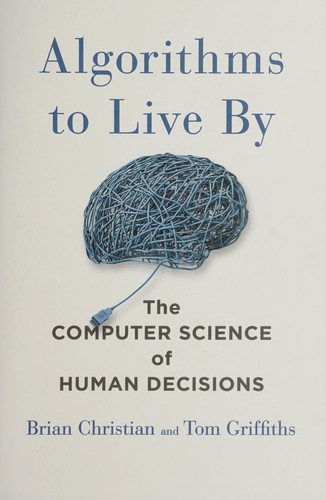
Talk to Algorithms to Live By: The Computer Science of Human Decisions like its author wrote you back.
Get the ideas that fit your life — not generic summaries.
- Chat with the book
- Audiobook-style main ideas
- Adapts to your life and goals
- Helps you take action
What it argues
Brian Christian is a writer and Tom Griffiths is a cognitive scientist, and together they argue that computer science has worked out rigorous solutions to many of the problems humans face every day — when to stop searching for a better option, how to manage your schedule, how to sort your memory — and that these solutions are both interesting and useful. Algorithms to Live By, published in 2016, is an accessible account of those solutions and their implications for how we make decisions.
The book begins with the optimal stopping problem: when should you stop searching and commit to the best option you have found so far? The mathematical solution — look at 37 percent of your options without choosing, then pick the next option better than anything seen so far — gives you the best possible odds of choosing the best option overall. This applies to hiring, apartment hunting, and, in the book's famous framing, the secretary problem and romantic search. The 37 percent rule will not always get you the best outcome, but it is the strategy that maximizes the probability of success.
What it gets right
- 1.
The optimal stopping rule: look at 37 percent of your options without choosing, then select the next option that is better than anything seen so far. This maximizes the probability of finding the best option.
- 2.
The explore-exploit tradeoff: time spent exploring options has a cost — opportunity cost — that means the balance between trying new things and sticking with what works depends on how much time you have left.
- 3.
Sorting algorithms suggest that keeping things in roughly sorted order is often more efficient than perfect sorting — the cost of perfect organization exceeds the benefit for most real information sets.
What it covers
Who wrote it
Brian Christian is a poet, programmer, and author who has written extensively on artificial intelligence and human cognition. His other books include The Alignment Problem and The Most Human Human. Tom Griffiths is Henry R. Luce Professor of Information Technology, Consciousness, and Culture at Princeton University, where he directs the Computational Cognitive Science Lab. His research focuses on how people make inferences under uncertainty and how the mind can be understood as a computational system. The two collaborators met at UC Berkeley.
