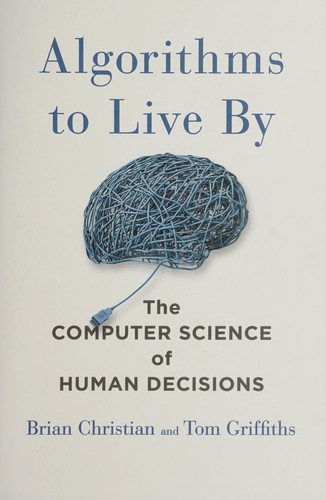
Algorithms to Live By: The Computer Science of Human Decisions by Brian Christian and Tom Griffiths is a 2016 psychology book about decision-making, algorithms, cognitive science. The optimal stopping rule: look at 37 percent of your options without choosing, then select the next option that is better than anything seen so far. This maximizes the probability of finding the best option.
Summary
Brian Christian is a writer and Tom Griffiths is a cognitive scientist, and together they argue that computer science has worked out rigorous solutions to many of the problems humans face every day — when to stop searching for a better option, how to manage your schedule, how to sort your memory — and that these solutions are both interesting and useful. Algorithms to Live By, published in 2016, is an accessible account of those solutions and their implications for how we make decisions.
The book begins with the optimal stopping problem: when should you stop searching and commit to the best option you have found so far? The mathematical solution — look at 37 percent of your options without choosing, then pick the next option better than anything seen so far — gives you the best possible odds of choosing the best option overall. This applies to hiring, apartment hunting, and, in the book's famous framing, the secretary problem and romantic search. The 37 percent rule will not always get you the best outcome, but it is the strategy that maximizes the probability of success.
Subsequent chapters cover the explore-exploit tradeoff, sorting algorithms applied to filing and memory, caching applied to what to keep close at hand, Bayes' theorem applied to what to believe about uncertain events, and game theory applied to social situations. Each chapter connects a well-defined mathematical problem to a human decision context, shows the optimal computational solution, and then discusses what the solution implies.
The book is more nuanced than its premise might suggest. Christian and Griffiths consistently acknowledge that mathematical optimality and human optimality are not the same thing, that context matters, and that computational solutions often depend on assumptions about the structure of the problem that human life may not satisfy. The final chapter on computational kindness — structuring your requests and environments to reduce the cognitive load on others — is one of the more genuinely novel applications of the framework. Throughout, the writing is clear and the mathematics is handled gracefully without becoming inaccessible.
Talk to Algorithms to Live By: The Computer Science of Human Decisions like its author wrote you back.
Get the ideas that fit your life — not generic summaries.
- Chat with the book
- Audiobook-style main ideas
- Adapts to your life and goals
- Helps you take action
Key takeaways
- 1.
The optimal stopping rule: look at 37 percent of your options without choosing, then select the next option that is better than anything seen so far. This maximizes the probability of finding the best option.
- 2.
The explore-exploit tradeoff: time spent exploring options has a cost — opportunity cost — that means the balance between trying new things and sticking with what works depends on how much time you have left.
- 3.
Sorting algorithms suggest that keeping things in roughly sorted order is often more efficient than perfect sorting — the cost of perfect organization exceeds the benefit for most real information sets.
- 4.
Caching principles: keep what you use most often closest at hand. The brain's memory system already does this; deliberate organization of physical spaces and digital files can apply the same logic.
- 5.
Bayesian reasoning provides a framework for updating beliefs in proportion to evidence. Many everyday judgment errors come from failures to apply Bayesian reasoning correctly — particularly ignoring base rates.
- 6.
Randomized algorithms — using randomness deliberately — are often more efficient than deterministic approaches, and some human behaviors that look like errors are actually reasonable heuristic approximations of random strategies.
- 7.
Computational kindness: structuring your requests, your schedule, and your environment to reduce the algorithmic complexity imposed on others is a form of social consideration — making other people's optimization problems easier.
Discussion questions
Use these on your own, with a book club, or as chat starters in Superbook. Book club version, ready to copy or print →
- 1.
The 37 percent rule is elegant but depends on assumptions about how much of your option space you can inspect. How well do those assumptions fit the kinds of decisions you face in work or relationships?
- 2.
The explore-exploit tradeoff depends on time horizon. How does your current career or life stage affect how much you should be exploring versus exploiting what you have already found?
- 3.
The book applies sorting algorithms to filing and organizing. Do you currently sort your information environment? What would computational sorting principles suggest you do differently?
- 4.
Bayesian reasoning requires updating on base rates, not just individual evidence. Can you identify a current belief you hold that probably underweights base rates?
- 5.
The authors argue that many human cognitive patterns that look like errors are actually reasonable approximations of computationally expensive algorithms. Does that make those patterns feel more or less concerning?
- 6.
Computational kindness — making other people's optimization problems easier — is an unusual ethical frame. What would it look like to apply it to how you make requests of colleagues or family members?
- 7.
The secretary problem has been used as a model of romantic search. How do you react to that framing — is mathematical modeling of relationship decisions useful, alienating, or both?
- 8.
The book argues that when you have too little information, you should explore more; when you have lots, you should exploit. At what point in most important decisions in your life do you actually have enough information?
- 9.
Overfitting is the error of building a model too closely matched to past data that performs poorly on new data. Where do you see overfitting operating in how you or your organization draws lessons from experience?
- 10.
The book proposes that computational thinking illuminates human cognition. What does it fail to illuminate — what aspects of human decision-making resist algorithmic framing?
- 11.
Which algorithm covered in the book do you find most directly applicable to a current practical challenge in your life?
Themes
Frequently asked questions
-
Do I need a computer science background to read this book?
No. The mathematical ideas are explained from scratch with clear examples and analogies. The book is aimed at general readers with no technical background required.
-
What is the optimal stopping problem?
The problem of deciding when to stop searching and commit to the best option found so far. The mathematical solution is to inspect 37 percent of the total option pool without choosing, then select the first option better than anything seen so far. This maximizes the probability of choosing the overall best option.
-
Is this a practical book or a theoretical one?
Both. The chapters explain the theory and then discuss real applications — hiring, apartment hunting, email management, memory organization. The applications are sometimes metaphorical rather than strictly prescriptive, but the authors are consistently interested in practical implications.
-
What is the explore-exploit tradeoff?
The decision between trying new options (exploration) and using the best option you have already found (exploitation). The optimal balance depends on time horizon: if you have lots of time left, exploring is valuable; if time is short, exploiting what you know works is better.
-
What is the most memorable idea in the book?
For most readers, either the 37 percent rule for optimal stopping or the concept of computational kindness — framing your requests and interactions to minimize the algorithmic complexity you impose on others. Both are memorable because they apply precise reasoning to domains where that precision is unexpected.
Similar books
Thinking, Fast and Slow
Daniel Kahneman
The Paradox of Choice: Why More Is Less
Barry Schwartz
Thinking in Bets: Making Smarter Decisions When You Don't Have All the Facts
Annie Duke
Noise: A Flaw in Human Judgment
Daniel Kahneman, Olivier Sibony, and Cass R. Sunstein
