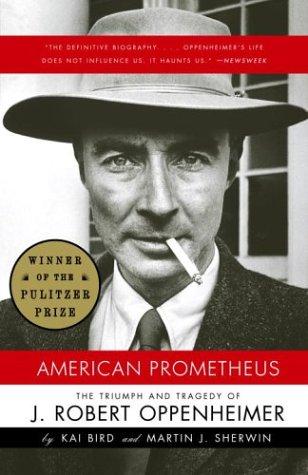
Talk to American Prometheus like its author wrote you back.
Get the ideas that fit your life — not generic summaries.
- Chat with the book
- Audiobook-style main ideas
- Adapts to your life and goals
- Helps you take action
American Prometheus, in detail
Kai Bird and Martin J. Sherwin's biography of J. Robert Oppenheimer — theoretical physicist, director of the Los Alamos laboratory during the Manhattan Project, and security-clearance casualty of the McCarthy era — is one of the great American biographies and the source for Christopher Nolan's 2023 film. Published in 2005 after twenty-five years of research, it is based on over a hundred interviews, recently declassified FBI files, and the private papers of hundreds of people who knew Oppenheimer. It won the Pulitzer Prize for Biography.
Oppenheimer was, by almost any measure, the most intellectually formidable American scientist of the twentieth century. His range was extraordinary — physics, philosophy, Sanskrit literature, French poetry, Eastern religion — and his ability to absorb and synthesize complex ideas across disciplines made him an unusual figure even in the extraordinary intellectual company of prewar Berkeley. The biography traces his formation through a privileged but emotionally difficult New York childhood, his Harvard education, his graduate study in Europe in the years when quantum mechanics was being invented, and his return to Berkeley where he built the leading theoretical physics program in the country.
The Los Alamos chapters are the book's dramatic center. Oppenheimer was chosen to direct the bomb laboratory not despite his complex political associations — he had been close to Communist Party members in the late 1930s and early 1940s — but because of his organizational genius and his ability to hold together an unprecedented assembly of scientific talent. The bomb's success, and Oppenheimer's famous quotation of the Bhagavad Gita at the Trinity test ("Now I am become Death, the destroyer of worlds"), made him a public figure of enormous symbolic weight.
The security hearings of 1954 are the biography's tragedy. Oppenheimer's clearance was revoked after a proceeding that combined genuine security concerns about his pre-war associations, personal rivalries within the scientific community, and the coordinated enmity of Edward Teller and Lewis Strauss. Bird and Sherwin are meticulous in their account of who did what to whom and why, and their conclusion — that Oppenheimer was the victim of a politically motivated witch hunt conducted with procedural manipulations that would not have survived legal scrutiny — is carefully documented.
The big ideas
- 1.
The Manhattan Project required both scientific and political genius. Oppenheimer's achievement at Los Alamos was organizational and interpersonal as much as it was scientific.
- 2.
Security clearance proceedings in the McCarthy era were as much about political loyalty as actual security. The 1954 hearing was shaped by personal enmities — particularly Teller's testimony — as much as by genuine concerns.
- 3.
Moral complexity follows from the bomb's existence, not just its use. Oppenheimer spent the rest of his life wrestling with what he had helped create, and his attempts to slow the hydrogen bomb program reflected this.
