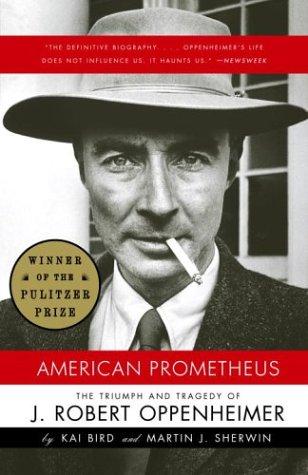
American Prometheus by Kai Bird and Martin J. Sherwin is a 2005 biography book about science, politics, mccarthyism. The Manhattan Project required both scientific and political genius. Oppenheimer's achievement at Los Alamos was organizational and interpersonal as much as it was scientific.
Summary
Kai Bird and Martin J. Sherwin's biography of J. Robert Oppenheimer — theoretical physicist, director of the Los Alamos laboratory during the Manhattan Project, and security-clearance casualty of the McCarthy era — is one of the great American biographies and the source for Christopher Nolan's 2023 film. Published in 2005 after twenty-five years of research, it is based on over a hundred interviews, recently declassified FBI files, and the private papers of hundreds of people who knew Oppenheimer. It won the Pulitzer Prize for Biography.
Oppenheimer was, by almost any measure, the most intellectually formidable American scientist of the twentieth century. His range was extraordinary — physics, philosophy, Sanskrit literature, French poetry, Eastern religion — and his ability to absorb and synthesize complex ideas across disciplines made him an unusual figure even in the extraordinary intellectual company of prewar Berkeley. The biography traces his formation through a privileged but emotionally difficult New York childhood, his Harvard education, his graduate study in Europe in the years when quantum mechanics was being invented, and his return to Berkeley where he built the leading theoretical physics program in the country.
The Los Alamos chapters are the book's dramatic center. Oppenheimer was chosen to direct the bomb laboratory not despite his complex political associations — he had been close to Communist Party members in the late 1930s and early 1940s — but because of his organizational genius and his ability to hold together an unprecedented assembly of scientific talent. The bomb's success, and Oppenheimer's famous quotation of the Bhagavad Gita at the Trinity test ("Now I am become Death, the destroyer of worlds"), made him a public figure of enormous symbolic weight.
The security hearings of 1954 are the biography's tragedy. Oppenheimer's clearance was revoked after a proceeding that combined genuine security concerns about his pre-war associations, personal rivalries within the scientific community, and the coordinated enmity of Edward Teller and Lewis Strauss. Bird and Sherwin are meticulous in their account of who did what to whom and why, and their conclusion — that Oppenheimer was the victim of a politically motivated witch hunt conducted with procedural manipulations that would not have survived legal scrutiny — is carefully documented.
Talk to American Prometheus like its author wrote you back.
Get the ideas that fit your life — not generic summaries.
- Chat with the book
- Audiobook-style main ideas
- Adapts to your life and goals
- Helps you take action
Key takeaways
- 1.
The Manhattan Project required both scientific and political genius. Oppenheimer's achievement at Los Alamos was organizational and interpersonal as much as it was scientific.
- 2.
Security clearance proceedings in the McCarthy era were as much about political loyalty as actual security. The 1954 hearing was shaped by personal enmities — particularly Teller's testimony — as much as by genuine concerns.
- 3.
Moral complexity follows from the bomb's existence, not just its use. Oppenheimer spent the rest of his life wrestling with what he had helped create, and his attempts to slow the hydrogen bomb program reflected this.
- 4.
Scientific community rivalries can be professionally and politically lethal. Teller's testimony against Oppenheimer ended a career and damaged a man; the personal and the institutional were inseparable.
- 5.
FBI surveillance of prominent intellectuals was extensive and deeply integrated into security proceedings. The files Bird and Sherwin accessed revealed a level of monitoring that Oppenheimer could not have guessed.
- 6.
Oppenheimer's prewar Communist associations were genuine but reflected a specific historical moment — the Depression, the Spanish Civil War — when Communist Party involvement was common among intellectuals.
- 7.
Twenty-five years of research is audible in the book's density. The biography achieves the comprehensiveness of a life fully reconstructed from primary sources.
- 8.
The 1963 Fermi Award, given to Oppenheimer by President Johnson, was a partial rehabilitation but not a restoration. The clearance revocation was never formally overturned during his lifetime. Biden posthumously overturned it in 2022.
Discussion questions
Use these on your own, with a book club, or as chat starters in Superbook. Book club version, ready to copy or print →
- 1.
Oppenheimer's security clearance was revoked partly on the basis of associations from twenty years earlier. How should governments weigh past political associations against subsequent service?
- 2.
Edward Teller's testimony against Oppenheimer is one of the most controversial episodes in the history of American science. How do you evaluate his decision?
- 3.
Oppenheimer quoted the Bhagavad Gita at the Trinity test. What does that choice say about his inner life, and how does the biography contextualize it?
- 4.
The book took twenty-five years to research and write. Is there something the length of that research adds to the biography that could not be achieved more quickly?
- 5.
Oppenheimer tried to slow the hydrogen bomb program after the war. Was this an act of conscience or an act of strategic miscalculation?
- 6.
Lewis Strauss emerges as a villain in the biography. Does the book treat him fairly?
- 7.
The bomb was used on Japan. Oppenheimer expressed regret, but continued to work on nuclear weapons policy. How do you reconcile those two facts?
- 8.
The biography is the basis for Nolan's film. What does the film change or simplify that the book preserves?
- 9.
Oppenheimer's intellectual range — Sanskrit, poetry, physics, philosophy — was extraordinary. Does the biography give you a sense of how those different domains interacted in his thinking?
- 10.
The clearance revocation was overturned by President Biden in 2022. Does posthumous vindication matter?
- 11.
What does American Prometheus suggest about the relationship between scientific achievement and political vulnerability in the United States?
Themes
Frequently asked questions
-
Is American Prometheus the definitive Oppenheimer biography?
It is widely regarded as such. The research base — declassified FBI files, private papers, over a hundred interviews — is unmatched by earlier biographies. It was also effectively confirmed as the standard account by the Academy Award-winning film adaptation.
-
How long does American Prometheus take to read?
About fifteen to eighteen hours. At nearly 600 pages of main text plus extensive notes, it rewards sustained reading rather than casual dipping. The Los Alamos and security hearing sections are the most propulsive; the prewar Berkeley chapters require more patience.
-
Does the book require knowledge of physics?
No. The authors explain the relevant physics clearly, and the technical dimensions are never the book's center. The book is primarily about a man, a political moment, and a moral problem.
-
How does the film compare to the book?
The film concentrates on the security hearing and the bomb project; the book covers Oppenheimer's entire life with equal depth. The biography is significantly richer on his prewar intellectual formation, his personal relationships, and the political machinations around the hearing. They reward each other.
-
Was Oppenheimer actually a security risk?
Bird and Sherwin's documented conclusion is no. His prewar Communist associations were real but dated, and there is no evidence he ever passed information to the Soviets or intended to compromise the bomb program. The hearing was driven by personal enmities and political climate more than genuine security evidence.
Similar books
A Beautiful Mind
Sylvia Nasar
The Soul of a New Machine
Tracy Kidder
The Innovators: How a Group of Hackers, Geniuses, and Geeks Created the Digital Revolution
Walter Isaacson
