Talk to An Everyone Culture like its author wrote you back.
Get the ideas that fit your life — not generic summaries.
- Chat with the book
- Audiobook-style main ideas
- Adapts to your life and goals
- Helps you take action
An Everyone Culture, in detail
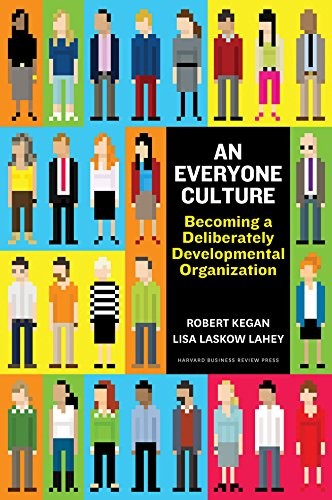
An Everyone Culture introduces what Robert Kegan and Lisa Laskow Lahey call the Deliberately Developmental Organization — a company designed around the idea that the work of personal growth and the work of business performance are not separate activities but the same thing. Most organizations, the authors argue, require employees to hide their weaknesses, manage impressions, and leave their developmental edge at the door. The enormous cost of this hidden curriculum — in energy spent on self-protection rather than problem-solving — goes largely unmeasured.
The book profiles three companies — Bridgewater Associates, Next Jump, and Decurion Corporation — that have built cultures explicitly oriented toward continuous personal development. At these organizations, surfacing weaknesses is not just permitted but expected. Feedback is not a performance review ritual but a daily practice. Leaders model vulnerability rather than authority. The authors make the case that this approach is not just humanistically appealing but economically productive: organizations that help people grow create better decisions, lower turnover, and deeper retention of institutional knowledge.
The theoretical backbone is Kegan's developmental model, particularly the distinction between the socialized mind and the self-authoring mind. Most workplaces actively suppress development toward self-authorship by rewarding compliance and conformity. A Deliberately Developmental Organization does the opposite: it creates conditions in which the challenges of real work become the occasion for the kind of growth that conventional training programs can't produce. The "edge" — the boundary of someone's current competence — is treated as a resource rather than a liability.
The book is demanding. The case studies are detailed and the theory is present throughout. The three profiled organizations are unusual enough that some readers will find the framework hard to translate to their own context — particularly when one of the companies is Bridgewater, which is known as an extreme workplace even by the standards of the book's developmental framing. But for leaders willing to rethink the relationship between organizational performance and human development, no other book makes the case as rigorously or as ambitiously.
The big ideas
- 1.
Most organizations demand that employees hide weaknesses and perform competence, creating a massive hidden tax on energy and honesty.
- 2.
A Deliberately Developmental Organization treats the work itself as the vehicle for personal development, not a separate training or coaching program.
- 3.
The gap between who we present ourselves to be at work and who we actually are costs organizations more than they realize in authenticity, risk-taking, and quality of decision-making.
