An Everyone Culture by Robert Kegan and Lisa Laskow Lahey is a 2016 business book about organizational culture, leadership development, adult development. Most organizations demand that employees hide weaknesses and perform competence, creating a massive hidden tax on energy and honesty.
Summary
An Everyone Culture introduces what Robert Kegan and Lisa Laskow Lahey call the Deliberately Developmental Organization — a company designed around the idea that the work of personal growth and the work of business performance are not separate activities but the same thing. Most organizations, the authors argue, require employees to hide their weaknesses, manage impressions, and leave their developmental edge at the door. The enormous cost of this hidden curriculum — in energy spent on self-protection rather than problem-solving — goes largely unmeasured.
The book profiles three companies — Bridgewater Associates, Next Jump, and Decurion Corporation — that have built cultures explicitly oriented toward continuous personal development. At these organizations, surfacing weaknesses is not just permitted but expected. Feedback is not a performance review ritual but a daily practice. Leaders model vulnerability rather than authority. The authors make the case that this approach is not just humanistically appealing but economically productive: organizations that help people grow create better decisions, lower turnover, and deeper retention of institutional knowledge.
The theoretical backbone is Kegan's developmental model, particularly the distinction between the socialized mind and the self-authoring mind. Most workplaces actively suppress development toward self-authorship by rewarding compliance and conformity. A Deliberately Developmental Organization does the opposite: it creates conditions in which the challenges of real work become the occasion for the kind of growth that conventional training programs can't produce. The "edge" — the boundary of someone's current competence — is treated as a resource rather than a liability.
The book is demanding. The case studies are detailed and the theory is present throughout. The three profiled organizations are unusual enough that some readers will find the framework hard to translate to their own context — particularly when one of the companies is Bridgewater, which is known as an extreme workplace even by the standards of the book's developmental framing. But for leaders willing to rethink the relationship between organizational performance and human development, no other book makes the case as rigorously or as ambitiously.
Talk to An Everyone Culture like its author wrote you back.
Get the ideas that fit your life — not generic summaries.
- Chat with the book
- Audiobook-style main ideas
- Adapts to your life and goals
- Helps you take action
Key takeaways
- 1.
Most organizations demand that employees hide weaknesses and perform competence, creating a massive hidden tax on energy and honesty.
- 2.
A Deliberately Developmental Organization treats the work itself as the vehicle for personal development, not a separate training or coaching program.
- 3.
The gap between who we present ourselves to be at work and who we actually are costs organizations more than they realize in authenticity, risk-taking, and quality of decision-making.
- 4.
Surfacing weaknesses and developmental edges requires psychological safety at a level most organizations don't achieve — and that leaders must model, not just mandate.
- 5.
The transition from a socialized mind (defined by others' expectations) to a self-authoring mind (driven by internal standards) is the developmental move most workplaces inadvertently block.
- 6.
Development-focused cultures need three things: edge (sufficient challenge), home (sufficient safety), and groove (repeated practice that makes new behaviors habitual).
- 7.
Feedback in a Deliberately Developmental Organization is not annual or hierarchical — it's continuous, peer-to-peer, and treated as a gift rather than a verdict.
- 8.
The cultures described in this book are not for every organization. The demands they place on employees are real, and people who thrive in more conventional environments may find them genuinely uncomfortable.
Discussion questions
Use these on your own, with a book club, or as chat starters in Superbook. Book club version, ready to copy or print →
- 1.
Kegan and Lahey argue that most workplaces require a hidden self-protective curriculum. How much energy do you spend managing impressions rather than solving problems at work?
- 2.
What weakness or developmental edge are you currently managing to keep others from seeing? What would it cost you to surface it in your team?
- 3.
What would your organization have to change for continuous peer feedback to be genuinely welcomed rather than defensively tolerated?
- 4.
The three companies profiled — Bridgewater, Next Jump, and Decurion — are unusual. What makes their practices feel replicable or not replicable in your context?
- 5.
Kegan distinguishes the socialized mind from the self-authoring mind. Which better describes how you operate in your current workplace, and what drives that?
- 6.
The book argues that leaders must model vulnerability before they can build a Deliberately Developmental culture. What does modeling vulnerability look like in practice, and where is the line between vulnerability and instability?
- 7.
Have you worked in an organization that took personal development seriously at a cultural level? How did it compare to the DDO model described here?
- 8.
What is the biggest organizational benefit you can imagine from a workplace where people bring their real developmental struggles to work? What is the biggest risk?
- 9.
The authors acknowledge that Bridgewater is an extreme example. What about its culture would you borrow, and what would you explicitly not import?
- 10.
Kegan's framework suggests that most adults are developmentally constrained by the social systems they inhabit. What change in your organization would give people more room to grow?
- 11.
An Everyone Culture argues that conventional training programs are largely ineffective because they're separated from real work. Where have you seen that pattern, and where have you seen exceptions?
- 12.
What specific practice from this book — daily feedback, working with the edge, developmental accountability — could you experiment with in your current team?
Themes
Frequently asked questions
-
Is An Everyone Culture relevant if I'm not building a company from scratch?
Yes. The book includes discussion of how to introduce Deliberately Developmental practices within existing teams and organizations, not just at the founding level. Many of the specific practices — continuous feedback, working openly with weaknesses — can be introduced incrementally.
-
How long does it take to read An Everyone Culture?
Six to seven hours. It's denser than most business books and rewards slow reading for the theoretical sections. The case studies are long but concrete. Readers who want the essence can focus on the first three chapters and the conclusion without losing the core argument.
-
What is a Deliberately Developmental Organization?
A company designed so that the daily work itself becomes the primary context for employees' personal development. Rather than separating performance management from development, a DDO treats growth as an organizational function, not an HR program — and expects everyone, including senior leaders, to work openly with their developmental edges.
-
Is An Everyone Culture compatible with An Everyone Culture?
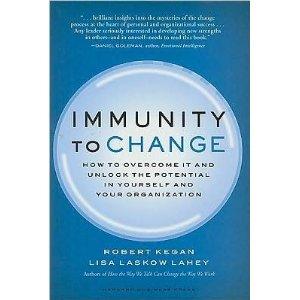
An Everyone Culture builds directly on Immunity to Change. Kegan and Lahey developed the four-column diagnostic exercise in the earlier book, and An Everyone Culture shows what organizations look like when they take that kind of self-examination seriously at a cultural level. Reading both strengthens both.
-
Who should read An Everyone Culture?
Senior leaders who are willing to reconsider fundamental assumptions about what organizations are for, HR executives building development programs, and coaches or consultants working with leadership teams. It's not a quick-fix book — it's an argument for a fundamentally different relationship between work and growth.