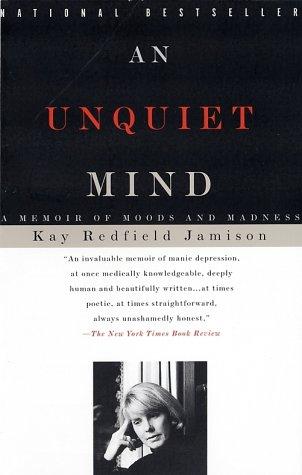
Talk to An Unquiet Mind like its author wrote you back.
Get the ideas that fit your life — not generic summaries.
- Chat with the book
- Audiobook-style main ideas
- Adapts to your life and goals
- Helps you take action
What it argues
Kay Redfield Jamison is a psychiatrist and professor who has manic-depressive illness. An Unquiet Mind, published in 1995, is her memoir of that illness and of what it cost her and gave her. It is unusual for two reasons: the author has clinical expertise in exactly the condition she describes, and she chose to write about it at a time when such disclosure carried serious professional risk.
The book follows Jamison from childhood through a manic episode in graduate school, a suicide attempt, and years of resistant coming to terms with lithium maintenance. She describes mania from the inside — the accelerating thoughts, the grandiosity, the spending sprees, the sexual recklessness — and depression with equal precision. What makes the account distinct from most illness memoirs is her refusal to resolve the ambivalence. She is not simply grateful for treatment. She mourns the loss of a certain kind of intensity that mania provided, even as she acknowledges it nearly killed her.
What it gets right
- 1.
Manic-depressive illness is not a character flaw or a weakness of will. It is a biological condition with a characteristic course that responds to specific treatments.
- 2.
The ambivalence about treatment is real, not irrational. Mood stabilizers reduce suffering but also flatten the highs that patients may have organized their identity around.
- 3.
Stigma in medicine is not abstract. Jamison documents specific ways her disclosure affected professional relationships, showing that psychiatric illness carries a different social burden than physical illness.
What it covers
Who wrote it
Kay Redfield Jamison is a professor of psychiatry at Johns Hopkins University School of Medicine and the co-director of the Johns Hopkins Mood Disorders Center. She is the author of several books, including Touched with Fire, which examines the relationship between mood disorders and artistic creativity, and Exuberance: The Passion for Life. She is a recipient of a MacArthur Fellowship and has been central to public understanding of bipolar disorder for three decades. An Unquiet Mind was one of the first accounts by a clinician of their own psychiatric illness to reach a wide public audience.
