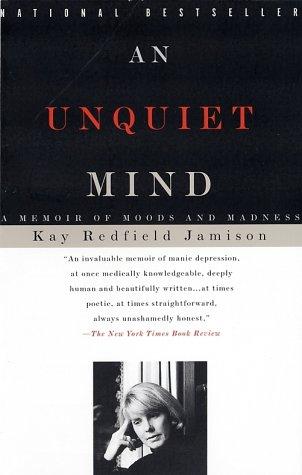
An Unquiet Mind by Kay Redfield Jamison is a 1995 psychology book about bipolar disorder, mental health, memoir. Manic-depressive illness is not a character flaw or a weakness of will. It is a biological condition with a characteristic course that responds to specific treatments.
Summary
Kay Redfield Jamison is a psychiatrist and professor who has manic-depressive illness. An Unquiet Mind, published in 1995, is her memoir of that illness and of what it cost her and gave her. It is unusual for two reasons: the author has clinical expertise in exactly the condition she describes, and she chose to write about it at a time when such disclosure carried serious professional risk.
The book follows Jamison from childhood through a manic episode in graduate school, a suicide attempt, and years of resistant coming to terms with lithium maintenance. She describes mania from the inside — the accelerating thoughts, the grandiosity, the spending sprees, the sexual recklessness — and depression with equal precision. What makes the account distinct from most illness memoirs is her refusal to resolve the ambivalence. She is not simply grateful for treatment. She mourns the loss of a certain kind of intensity that mania provided, even as she acknowledges it nearly killed her.
Jamison's clinical training shapes the memoir throughout. She can stand outside her own experience and analyze it, which creates both clarity and a particular kind of loneliness — the observer watching herself. She writes about the stigma that surrounds mental illness in medicine, about colleagues who treated her differently once they knew, and about the specific difficulty of accepting a chronic condition that affects mood, judgment, and the sense of self.
The book ends with a sustained argument for lithium and for treatment, but it is not a recovery narrative in the conventional sense. Jamison does not arrive at a place where the illness is behind her. She arrives at a place where she can live with it, work with it, and understand what it has taken from her and what it has unexpectedly given her. An Unquiet Mind remains one of the most honest and literary accounts of major psychiatric illness written by someone who has both lived it and studied it professionally.
Talk to An Unquiet Mind like its author wrote you back.
Get the ideas that fit your life — not generic summaries.
- Chat with the book
- Audiobook-style main ideas
- Adapts to your life and goals
- Helps you take action
Key takeaways
- 1.
Manic-depressive illness is not a character flaw or a weakness of will. It is a biological condition with a characteristic course that responds to specific treatments.
- 2.
The ambivalence about treatment is real, not irrational. Mood stabilizers reduce suffering but also flatten the highs that patients may have organized their identity around.
- 3.
Stigma in medicine is not abstract. Jamison documents specific ways her disclosure affected professional relationships, showing that psychiatric illness carries a different social burden than physical illness.
- 4.
Insight and illness coexist uneasily. Having clinical expertise about her own condition did not make Jamison immune to its distortions or to the temptation to stop medication.
- 5.
Suicide attempts are not manipulative or attention-seeking. Jamison's account of her own attempt makes clear how the suicidal state distorts perception and strips away alternatives.
- 6.
Treatment saves lives but is not a cure. Lithium allowed Jamison to function, but the illness remained, requiring ongoing management and acceptance.
- 7.
Disclosure is a choice with real costs. Jamison wrote openly at a time when that openness damaged careers. The decision to speak was itself a form of advocacy.
- 8.
The relationship between creativity and mood disorders is complex and contested. Jamison has written extensively on the association, but in this book she resists clean conclusions about what the illness gives versus takes.
Discussion questions
Use these on your own, with a book club, or as chat starters in Superbook. Book club version, ready to copy or print →
- 1.
Jamison describes mourning the loss of her hypomanic states even as she acknowledges the harm they caused. How do you think about ambivalence toward a condition that is both damaging and, in some ways, formative?
- 2.
She chose to write this book while still working as a psychiatrist and professor. What do you think that choice cost her, and what did it enable?
- 3.
Jamison writes about the specific difficulty of accepting a diagnosis that affects mood and judgment — the very faculties used to evaluate the diagnosis. How does that circularity complicate treatment?
- 4.
The book was published in 1995. How do you think the conversation about mental illness disclosure has changed, and how has it stayed the same?
- 5.
Jamison describes a suicide attempt with clinical detachment as well as emotional immediacy. What effect did that combination have on you as a reader?
- 6.
She credits specific people — her psychiatrist, a friend, her brother — with keeping her alive. What does her account suggest about the role of relationships in mental illness?
- 7.
Jamison's expertise in her own condition gave her insight but also did not prevent the illness from progressing. What does that suggest about the limits of self-knowledge?
- 8.
The book is often assigned in medical schools. What do you think it teaches that case studies or textbooks cannot?
- 9.
Jamison has also written about the relationship between mood disorders and creativity among writers and artists. Did that dimension of her argument feel convincing to you?
- 10.
What is the difference between accepting a chronic illness and resigning yourself to it? Does Jamison achieve acceptance, resignation, or something else by the end?
- 11.
Who in your life might benefit from reading this book, and how would you describe it to them?
- 12.
What does the title mean to you after reading it?
Themes
Frequently asked questions
-
Is An Unquiet Mind a memoir or a clinical account?
Both. Jamison writes as someone who has lived with the illness and as someone who treats it professionally. The book moves between those registers throughout — sometimes within the same paragraph — which is much of what makes it unusual.
-
Is the book depressing?
It is serious and at times harrowing, but not without beauty. Jamison writes about mania with a kind of elegy, and about recovery with clear-eyed honesty rather than false uplift. Most readers find it moving rather than bleak.
-
What is manic-depressive illness, and is it the same as bipolar disorder?
The terms refer to the same condition. Manic-depressive illness is the older clinical term; bipolar disorder became the standard diagnostic name in the 1980s. Jamison uses both and has expressed a preference for the older term as more descriptively accurate.
-
Who should read this book?
Anyone who has mood disorder experience — their own or in someone they love. Also valuable for clinicians, therapists, and anyone interested in what it means to live with a chronic psychiatric condition. The writing is literary and accessible.
-
What is the most important thing the book says?
That psychiatric illness is real, that treatment works but is not simple, and that the people who live with serious mental illness are not defined by it. Jamison's combination of authority and vulnerability makes both of those claims more credible than most clinical writing can.