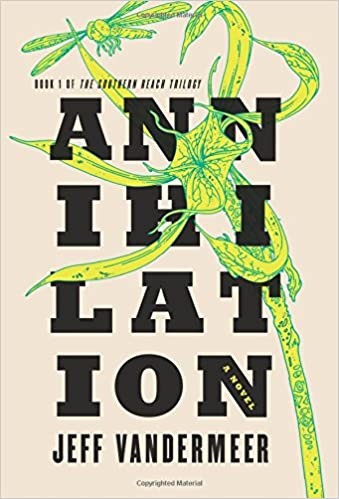
Talk to Annihilation like its author wrote you back.
Get the ideas that fit your life — not generic summaries.
- Chat with the book
- Audiobook-style main ideas
- Adapts to your life and goals
- Helps you take action
What it argues
A team of four unnamed women — the biologist, the anthropologist, the surveyor, and the psychologist — enter Area X, a forbidden coastal wilderness where something has gone wrong for decades. Previous expeditions have returned changed, or died, or not returned at all. The biologist narrates in the first person, writing in a journal as the expedition proceeds, and what she reports does not add up. Area X does not behave like nature. It does not behave like anything.
Annihilation is less concerned with explaining its mystery than with tracking what it does to the person observing it. The biologist is already somewhat apart from human relationships before she arrives; Area X seems designed to find exactly that gap and widen it. What the novel is actually about is the difficulty of knowing anything — another person, a place, yourself — when all information comes through unreliable instruments, and when the observer is changed by observation. VanderMeer is deeply influenced by the New Weird movement and ecological horror, and the book reads more like Borges or Kafka than like conventional science fiction.
What it gets right
- 1.
Area X refuses to be a metaphor. VanderMeer deliberately resists letting his setting collapse into allegory — it is strange in itself, not as a stand-in for something else.
- 2.
The biologist's unreliability as narrator is structural, not incidental — she admits she is changed, possibly contaminated, and her account of what she observes cannot be separated from what she has become.
- 3.
The tower that descends underground, the writing on the walls, the Crawler — VanderMeer's images are genuinely new, not assembled from existing genre parts.
What it covers
Who wrote it
Jeff VanderMeer is an American author associated with the New Weird movement in science fiction and fantasy. His Southern Reach trilogy — Annihilation, Authority, and Acceptance — was published in 2014 and received widespread critical acclaim; Annihilation won the Nebula Award and the Shirley Jackson Award. His novel Dead Astronauts and the nonfiction Wonderbook on creative writing have cemented his reputation as a writer who takes genre conventions seriously enough to dismantle them. He lives in Tallahassee, Florida, and is known for his ecological and environmental concerns.
