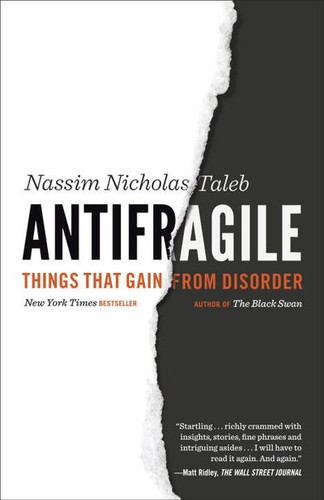
Talk to Antifragile: Things That Gain from Disorder like its author wrote you back.
Get the ideas that fit your life — not generic summaries.
- Chat with the book
- Audiobook-style main ideas
- Adapts to your life and goals
- Helps you take action
Antifragile: Things That Gain from Disorder, in detail
Antifragile is Nassim Nicholas Taleb's argument that the opposite of fragile is not robust or resilient — it is antifragile. Fragile things break under stress. Robust things absorb stress without changing. Antifragile things actually improve from volatility, disorder, and shock. Taleb's central claim is that nature, successful institutions, and durable individuals all have this quality, and that modern civilization keeps building fragile systems in the name of efficiency and predictability, setting itself up for catastrophic failures.
Taleb develops this idea across a sweeping range of domains: medicine, finance, urban planning, food, political systems, and personal careers. In each case he identifies the same pattern. Interventionism — the urge to smooth out variation, prevent small losses, and optimize for the known — creates hidden fragility. When the suppressed volatility eventually returns, it returns at scale. He calls this the "Soviet-Harvard delusion": the belief that top-down, planned, theory-first approaches can manage complex systems well. His preferred alternative is to let small stressors and failures do their corrective work before they compound into disasters.
The book introduces several practical concepts that give this philosophy concrete form. The barbell strategy recommends extreme caution at one end of any exposure and aggressive optionality at the other, avoiding the "middle" that looks safe but is in fact fragile to tail events. Via negativa — subtracting harmful things rather than adding helpful ones — appears repeatedly as a more reliable form of action than positive intervention. The notion of "skin in the game" (developed more fully in a later book) holds that decision-makers who bear no consequences for their errors will systematically make bad choices, and that no amount of modelling compensates for that missing accountability.
Taleb writes with deliberate provocation and more than a little contempt for what he calls "fragilistas" — economists, doctors, urban planners, and policy advisors who mistake their models for reality. This voice divides readers sharply. The ideas are genuinely powerful, but the book is long, repetitive in places, and padded with digressions and score-settling that dilute the core argument. Readers willing to extract the signal from the noise will find a framework for thinking about uncertainty that holds up well across a decade of financial crises, pandemic responses, and institutional failures. Readers expecting a tight, practical manual will find it frustrating. The most useful posture is to read it as a philosophical provocation and apply the concepts selectively rather than wholesale.
The big ideas
- 1.
Antifragility is not resilience. Resilient things survive shocks; antifragile things get stronger from them. Most institutions are optimized to be robust but are actually fragile when large shocks arrive.
- 2.
Suppressing volatility makes systems more fragile, not more stable. Small controlled fires prevent forest infernos. Small business failures prevent economic collapses.
- 3.
The barbell strategy: combine extreme caution in one domain with aggressive optionality in another. Avoid the middle ground that feels safe but has hidden tail risk.
