Antifragile: Things That Gain from Disorder by Nassim Nicholas Taleb is a 2012 philosophy book about antifragility, risk and uncertainty, optionality. Antifragility is not resilience. Resilient things survive shocks; antifragile things get stronger from them. Most institutions are optimized to be robust but are actually fragile when large shocks arrive.
Summary
Antifragile is Nassim Nicholas Taleb's argument that the opposite of fragile is not robust or resilient — it is antifragile. Fragile things break under stress. Robust things absorb stress without changing. Antifragile things actually improve from volatility, disorder, and shock. Taleb's central claim is that nature, successful institutions, and durable individuals all have this quality, and that modern civilization keeps building fragile systems in the name of efficiency and predictability, setting itself up for catastrophic failures.
Taleb develops this idea across a sweeping range of domains: medicine, finance, urban planning, food, political systems, and personal careers. In each case he identifies the same pattern. Interventionism — the urge to smooth out variation, prevent small losses, and optimize for the known — creates hidden fragility. When the suppressed volatility eventually returns, it returns at scale. He calls this the "Soviet-Harvard delusion": the belief that top-down, planned, theory-first approaches can manage complex systems well. His preferred alternative is to let small stressors and failures do their corrective work before they compound into disasters.
The book introduces several practical concepts that give this philosophy concrete form. The barbell strategy recommends extreme caution at one end of any exposure and aggressive optionality at the other, avoiding the "middle" that looks safe but is in fact fragile to tail events. Via negativa — subtracting harmful things rather than adding helpful ones — appears repeatedly as a more reliable form of action than positive intervention. The notion of "skin in the game" (developed more fully in a later book) holds that decision-makers who bear no consequences for their errors will systematically make bad choices, and that no amount of modelling compensates for that missing accountability.
Taleb writes with deliberate provocation and more than a little contempt for what he calls "fragilistas" — economists, doctors, urban planners, and policy advisors who mistake their models for reality. This voice divides readers sharply. The ideas are genuinely powerful, but the book is long, repetitive in places, and padded with digressions and score-settling that dilute the core argument. Readers willing to extract the signal from the noise will find a framework for thinking about uncertainty that holds up well across a decade of financial crises, pandemic responses, and institutional failures. Readers expecting a tight, practical manual will find it frustrating. The most useful posture is to read it as a philosophical provocation and apply the concepts selectively rather than wholesale.
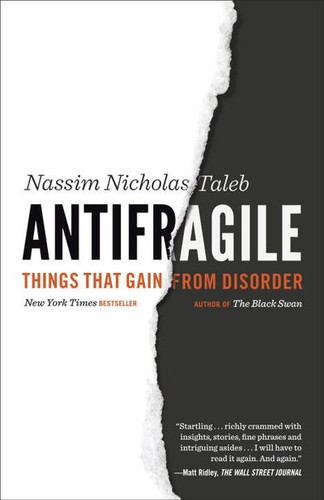
Talk to Antifragile: Things That Gain from Disorder like its author wrote you back.
Get the ideas that fit your life — not generic summaries.
- Chat with the book
- Audiobook-style main ideas
- Adapts to your life and goals
- Helps you take action
Key takeaways
- 1.
Antifragility is not resilience. Resilient things survive shocks; antifragile things get stronger from them. Most institutions are optimized to be robust but are actually fragile when large shocks arrive.
- 2.
Suppressing volatility makes systems more fragile, not more stable. Small controlled fires prevent forest infernos. Small business failures prevent economic collapses.
- 3.
The barbell strategy: combine extreme caution in one domain with aggressive optionality in another. Avoid the middle ground that feels safe but has hidden tail risk.
- 4.
Via negativa — removing harmful things — is often more effective and more durable than adding interventions. What you don't do matters as much as what you do.
- 5.
Skin in the game is a prerequisite for good decision-making. When decision-makers bear no downside from their errors, the system loses its error-correction mechanism.
- 6.
The 'Soviet-Harvard delusion' is the belief that complex systems respond well to top-down planning. Nature, markets, and cities are antifragile because they run on distributed trial and error, not central design.
- 7.
Optionality is deeply undervalued. Having the option to act — without the obligation — gives you asymmetric exposure: limited downside, unlimited upside.
- 8.
Taleb's Lindy Effect: the longer a technology, idea, or institution has survived, the longer it is likely to survive. Age is a proxy for antifragility.
- 9.
Modern medicine, finance, and policy consistently overtreat, over-intervene, and over-optimize. The urge to do something often produces more harm than restraint would.
Discussion questions
Use these on your own, with a book club, or as chat starters in Superbook. Book club version, ready to copy or print →
- 1.
Taleb distinguishes fragile, robust, and antifragile. Where in your own life have you built fragility in the name of comfort or predictability?
- 2.
The barbell strategy recommends extreme caution at one end and aggressive optionality at the other. What would a barbell look like in your career or finances right now?
- 3.
Taleb argues that stressors and small failures are necessary information for a healthy system. What in your organization or life is being over-protected from stress in a way that might be creating hidden fragility?
- 4.
Via negativa says subtraction is often more powerful than addition. What is one thing you could remove from your life or work that would improve it more than adding something new?
- 5.
The Lindy Effect suggests old ideas and institutions have proven durability that new ones haven't. Which new thing in your field are you betting on that might not survive the Lindy test?
- 6.
Taleb is contemptuous of experts who bear no consequences for their advice. Who in your life or field makes high-stakes recommendations without skin in the game? How does that change how you should weigh their advice?
- 7.
Think of a large institution — a company, a government agency, a healthcare system — that you depend on. What would make it antifragile rather than merely robust?
- 8.
Taleb claims that nature learns by doing, not by theorizing. Where are you relying on a theory or plan when experimentation would teach you more?
- 9.
The book argues that over-optimization removes the slack and redundancy that systems need to survive shocks. Where in your work or life have you over-optimized in a way that left you exposed?
- 10.
Has a setback, failure, or period of disorder in your life ever made you better in a way that success wouldn't have? What did it require of you to extract that benefit?
- 11.
Taleb says the problem is not uncertainty but the illusion of certainty. Where are you most susceptible to false certainty right now?
- 12.
If you applied Taleb's framework to a decision you're currently facing, what would the fragile option be, the robust option, and the antifragile option?
Themes
Frequently asked questions
-
Is Antifragile worth reading?
Yes, if you're willing to work for it. The central idea — that some things benefit from disorder — is genuinely original and has wide application. The book is long and repetitive, and Taleb's combative style irritates many readers. A reasonable approach is to read closely for the first third, skim the middle sections for examples, and return to the final chapters for the synthesis.
-
How long does it take to read Antifragile?
Around ten to eleven hours at average reading pace for the 519-page book. Many readers spread it over several weeks. The chapters vary widely in density: the philosophical and financial sections reward slow reading; the anecdote-heavy middle sections can be skimmed without losing the thread.
-
What is the main idea of Antifragile?
That fragile and robust are not the only options — antifragile systems actively improve from shocks, volatility, and disorder. Taleb argues that nature, durable institutions, and wise individuals all exploit disorder rather than merely surviving it, and that modern civilization keeps building dangerously fragile systems by eliminating the small stressors that would otherwise keep them healthy.
-
Who should read Antifragile?
Investors, risk managers, policy thinkers, and anyone making decisions under genuine uncertainty. It's also valuable for entrepreneurs and career planners who want a framework for structuring exposure so that downside is capped and upside stays open. Readers who prefer precise, data-driven arguments will find Taleb's style frustrating.
-
How does Antifragile relate to The Black Swan?
The Black Swan describes the problem: rare, high-impact events that models consistently fail to predict. Antifragile is the response: how to position yourself so that those events help rather than destroy you. Reading both is worthwhile; The Black Swan is shorter and more focused, while Antifragile is wider-ranging and more prescriptive.
-
What is the barbell strategy?
Taleb's recommendation to split exposure between very safe and very speculative, avoiding the middle ground that appears moderate but carries hidden tail risk. In investing it might mean cash plus high-risk options, nothing in 'moderate-risk' bonds. In career terms, a stable income source plus an aggressive side project — never a single 'balanced' corporate track.
Similar books
The Black Swan: The Impact of the Highly Improbable
Nassim Nicholas Taleb
Thinking, Fast and Slow
Daniel Kahneman
Fooled by Randomness
Nassim Nicholas Taleb
Skin in the Game: Hidden Asymmetries in Daily Life
Nassim Nicholas Taleb
