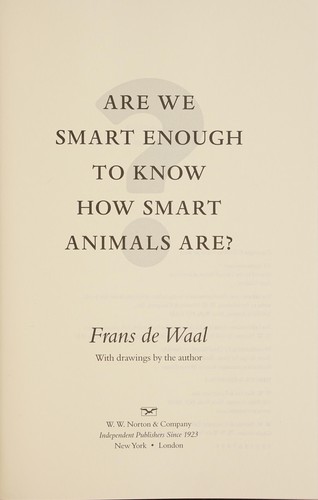
Talk to Are We Smart Enough to Know How Smart Animals Are? like its author wrote you back.
Get the ideas that fit your life — not generic summaries.
- Chat with the book
- Audiobook-style main ideas
- Adapts to your life and goals
- Helps you take action
Are We Smart Enough to Know How Smart Animals Are?, in detail
Frans de Waal's central argument is that we've spent most of the last century asking the wrong questions about animal intelligence. We designed tests to reveal what animals lack — the capacity to do what humans do — rather than to reveal what they actually do in their own ecological and social contexts. The result was a science that systematically underestimated every species it studied, from crows to chimpanzees to octopuses.
De Waal, a primatologist at Emory University, draws on decades of fieldwork and lab research to show that animal cognition is not a single ladder with humans at the top but a wide array of specialized abilities shaped by survival needs. Elephants demonstrate remarkable memory for other individuals and empathy for dying members of their group. Crows fashion tools they've never seen used by others. Chimpanzees pass social information through generations without human intervention. A cleaner wrasse fish passes a version of the mirror self-recognition test — a benchmark psychologists once thought reserved for the great apes.
The book is partly a scientific argument and partly a history of how anthropocentrism distorted the field. De Waal traces the influence of behaviorism, which held that attributing inner states to animals was unscientific, and of the arbitrary standard that tool use, language, or culture were uniquely human until proven otherwise in each case. He names this "anthropodenial" — the refusal to see human-like attributes in other species, the mirror image of naive anthropomorphism.
What makes the book persuasive is the accumulation of specific experiments and observations. De Waal never simply asserts that animals are smart; he describes the evidence carefully and honestly acknowledges where it is disputed. The conclusion is not that animals are small, furry humans, but that intelligence itself comes in many shapes, and that recognizing those shapes requires us to ask questions from inside each animal's umwelt — its particular sensory and social world — rather than measuring it against our own.
The big ideas
- 1.
Anthropocentrism has systematically biased animal cognition research. Tests designed to detect what animals can't do tell us little about what they can do in their own contexts.
- 2.
Intelligence is not a ladder but a wide bush. Different species have evolved different cognitive specializations suited to their ecological and social needs.
- 3.
Anthropodenial — the refusal to attribute mental states to animals — is as distorting as naive anthropomorphism. Both block accurate observation.
