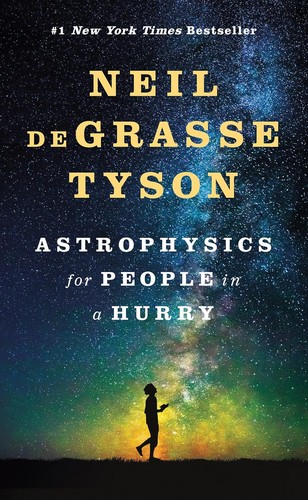
Talk to Astrophysics for People in a Hurry like its author wrote you back.
Get the ideas that fit your life — not generic summaries.
- Chat with the book
- Audiobook-style main ideas
- Adapts to your life and goals
- Helps you take action
Astrophysics for People in a Hurry, in detail
Astrophysics for People in a Hurry is Neil deGrasse Tyson's deliberately compact introduction to the biggest ideas in modern astrophysics. Assembled from essays Tyson originally wrote for Natural History magazine, the book covers the Big Bang, dark matter, dark energy, the cosmic microwave background, the elements, light, and the periodic table, all in under 200 pages. The premise is explicit: not everyone has time for a 400-page cosmology survey, but everyone deserves to know how the universe works.
The book opens with the first second after the Big Bang — the sequence of phase transitions as the universe cooled from an unimaginably hot, dense initial state into the matter and energy configuration we can observe today. Tyson explains why the early universe was dominated by radiation, how protons and neutrons formed and then combined into the lightest nuclei, and how the universe became transparent to light about 380,000 years after the Big Bang, producing the cosmic microwave background radiation still detectable today.
The middle chapters cover dark matter and dark energy — the two dominant but unknown components of the universe. Visible matter — stars, gas, planets — accounts for about 5% of the universe's total energy. Dark matter makes up 27%, inferred from its gravitational effects on galaxies but never directly detected. Dark energy makes up 68%, inferred from the observed acceleration of cosmic expansion but completely unexplained. Tyson writes about these unknowns with unusual candor: astrophysics does not know what most of the universe is made of.
The final chapters pivot from cosmology to chemistry and to Tyson's recurring theme: that the atoms in human bodies were forged in the cores of ancient stars, that we are cosmically connected to the universe in a literal physical sense. Tyson uses this to argue for a cosmic perspective — an appreciation of human smallness and interconnection — as a practical guide to living with less tribalism and more humility.
The big ideas
- 1.
In the first second after the Big Bang, the universe underwent a sequence of phase transitions from pure energy to the fundamental particles that make up all matter today.
- 2.
The cosmic microwave background — the afterglow of the hot early universe, now cooled to 2.7 degrees above absolute zero — is the oldest observable signal in the cosmos and is one of the strongest pieces of evidence for the Big Bang.
- 3.
Normal matter — everything we can see and touch — makes up only about 5% of the universe. Dark matter (27%) and dark energy (68%) dominate but are completely unknown in nature.
