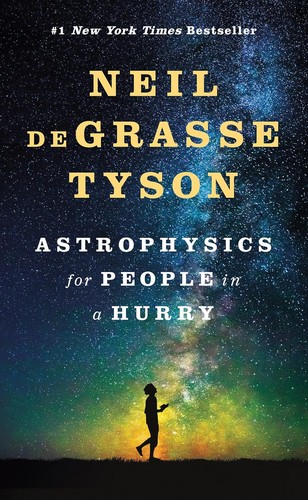
Astrophysics for People in a Hurry by Neil deGrasse Tyson is a 2017 science book about astrophysics, cosmology, dark matter. In the first second after the Big Bang, the universe underwent a sequence of phase transitions from pure energy to the fundamental particles that make up all matter today.
Summary
Astrophysics for People in a Hurry is Neil deGrasse Tyson's deliberately compact introduction to the biggest ideas in modern astrophysics. Assembled from essays Tyson originally wrote for Natural History magazine, the book covers the Big Bang, dark matter, dark energy, the cosmic microwave background, the elements, light, and the periodic table, all in under 200 pages. The premise is explicit: not everyone has time for a 400-page cosmology survey, but everyone deserves to know how the universe works.
The book opens with the first second after the Big Bang — the sequence of phase transitions as the universe cooled from an unimaginably hot, dense initial state into the matter and energy configuration we can observe today. Tyson explains why the early universe was dominated by radiation, how protons and neutrons formed and then combined into the lightest nuclei, and how the universe became transparent to light about 380,000 years after the Big Bang, producing the cosmic microwave background radiation still detectable today.
The middle chapters cover dark matter and dark energy — the two dominant but unknown components of the universe. Visible matter — stars, gas, planets — accounts for about 5% of the universe's total energy. Dark matter makes up 27%, inferred from its gravitational effects on galaxies but never directly detected. Dark energy makes up 68%, inferred from the observed acceleration of cosmic expansion but completely unexplained. Tyson writes about these unknowns with unusual candor: astrophysics does not know what most of the universe is made of.
The final chapters pivot from cosmology to chemistry and to Tyson's recurring theme: that the atoms in human bodies were forged in the cores of ancient stars, that we are cosmically connected to the universe in a literal physical sense. Tyson uses this to argue for a cosmic perspective — an appreciation of human smallness and interconnection — as a practical guide to living with less tribalism and more humility.
Talk to Astrophysics for People in a Hurry like its author wrote you back.
Get the ideas that fit your life — not generic summaries.
- Chat with the book
- Audiobook-style main ideas
- Adapts to your life and goals
- Helps you take action
Key takeaways
- 1.
In the first second after the Big Bang, the universe underwent a sequence of phase transitions from pure energy to the fundamental particles that make up all matter today.
- 2.
The cosmic microwave background — the afterglow of the hot early universe, now cooled to 2.7 degrees above absolute zero — is the oldest observable signal in the cosmos and is one of the strongest pieces of evidence for the Big Bang.
- 3.
Normal matter — everything we can see and touch — makes up only about 5% of the universe. Dark matter (27%) and dark energy (68%) dominate but are completely unknown in nature.
- 4.
Dark matter is inferred from its gravitational effects on galaxies: stars in the outer regions of galaxies rotate too fast to be held in orbit by the visible matter alone. Something unseen provides the extra gravity.
- 5.
Dark energy is inferred from the acceleration of cosmic expansion, discovered in 1998. Its nature is unknown, but it appears to be a property of empty space itself.
- 6.
The elements heavier than hydrogen and helium were forged inside stars through nuclear fusion and distributed into the cosmos by supernova explosions. The atoms in your body were made in stars that lived and died before the sun formed.
- 7.
The cosmic perspective — understanding human existence in the context of a 14-billion-year-old universe — is not a counsel of despair but a source of wonder and of proportionality about human conflicts.
- 8.
Scientific literacy in astrophysics — understanding the Big Bang, evolution of stars, and the scale of the cosmos — is a civic good that shapes how people reason about their place in the world.
Discussion questions
Use these on your own, with a book club, or as chat starters in Superbook. Book club version, ready to copy or print →
- 1.
The book is explicitly for people in a hurry. Does brevity enhance or limit its usefulness as an introduction to astrophysics?
- 2.
Tyson emphasizes that 95% of the universe is unknown — dark matter and dark energy. Does that level of ignorance surprise you, and how does it affect your confidence in astrophysics?
- 3.
The cosmic microwave background is the oldest directly observable signal in the universe. What does it feel like to know that the universe's origin is measurable in principle?
- 4.
Tyson argues that the cosmic perspective reduces tribalism and promotes humility. Is that an empirical claim or a hope?
- 5.
The atoms in your body were forged in stars. Does that knowledge change anything about how you experience your physical existence?
- 6.
Dark matter has never been directly detected despite decades of effort. At what point should scientists conclude a hypothesis is wrong rather than just hard to detect?
- 7.
Tyson is one of the most recognized science communicators in the world. Does his celebrity help or hurt how you evaluate the content of the book?
- 8.
The book was assembled from essays. Does that origin show in its structure, and does it matter?
- 9.
Astrophysics makes claims about events billions of years ago and billions of light-years away. How do you reason about the reliability of claims at those scales?
- 10.
The book ends with a chapter on being cosmically connected and humble. Is that an appropriate conclusion for a science book, or does it cross into advocacy?
- 11.
What question about the universe would you most want answered that the book raises but does not resolve?
Themes
Frequently asked questions
-
Is Astrophysics for People in a Hurry actually short?
Yes — under 200 pages, about three hours at average reading pace. It is one of the shortest accessible introductions to modern astrophysics available. The brevity is the explicit premise.
-
What level of background does it assume?
None. The book is written for complete non-specialists and avoids equations entirely. Readers with more astrophysics background may find it superficial, but it is not intended for them.
-
What is dark matter?
An unknown substance that makes up about 27% of the universe's total energy. It has never been directly detected but is inferred from gravitational effects — galaxies rotate as if they contain much more mass than their visible stars, gas, and dust account for.
-
What is the Big Bang?
The Big Bang is the event some 13.8 billion years ago when the observable universe began expanding from an extremely hot, dense state. It is not an explosion into pre-existing space but the beginning of spacetime itself. The evidence for it includes the cosmic microwave background radiation and the observed expansion of the universe.
-
How does it compare to Cosmos by Carl Sagan?
Sagan's Cosmos is broader, more humanistic, and more historically grounded. Tyson's book is shorter and more focused on the current state of astrophysics. Both share a wonder at the scale of the universe, but Sagan is more literary. Tyson is better for a quick orientation to modern cosmology.