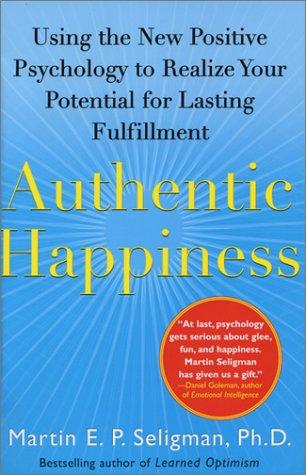
Talk to Authentic Happiness like its author wrote you back.
Get the ideas that fit your life — not generic summaries.
- Chat with the book
- Audiobook-style main ideas
- Adapts to your life and goals
- Helps you take action
What it argues
Authentic Happiness is Martin Seligman's founding statement of positive psychology — the scientific study of what makes life worth living. Published in 2002, it represents a deliberate counterweight to a century of psychology focused primarily on mental illness and dysfunction. Seligman, a former president of the American Psychological Association, argues that psychology's mandate should include cultivating happiness, not merely treating suffering, and that this project can be grounded in rigorous science rather than self-help intuition.
The book's central framework divides happiness into three elements: positive emotion (pleasure and good feeling), engagement (absorption in activities that use one's strengths), and meaning (belonging to and serving something larger than oneself). Seligman draws on decades of research — including studies of twins, accident victims, lottery winners, and nuns — to argue that while roughly 50 percent of one's happiness set point is genetically determined and another 10 percent is circumstantial, the remaining 40 percent is within voluntary control. This is not a book that promises effortless happiness, but it does claim that specific activities and orientations reliably increase well-being for most people.
What it gets right
- 1.
Positive psychology is the scientific study of what makes life worth living, not just the absence of illness. It includes flourishing, virtue, and meaning as legitimate objects of inquiry.
- 2.
Happiness has three components: positive emotion (the pleasant life), engagement (the engaged life), and meaning (the meaningful life). Each can be pursued separately.
- 3.
Roughly half of individual happiness variation is determined by genetics. Circumstance — income, health, relationships — explains far less than people expect. The remaining 40 percent is within voluntary influence.
What it covers
Who wrote it
Martin E. P. Seligman is a psychologist and professor at the University of Pennsylvania, where he directs the Positive Psychology Center. He served as president of the American Psychological Association in 1998 and used his presidential address to launch the positive psychology movement. His earlier research on learned helplessness and explanatory style, documented in Learned Optimism, established his reputation in experimental psychology before he turned his attention to flourishing and well-being. He has written more than twenty books and his work has influenced clinical psychology, education, and organizational behavior worldwide.
