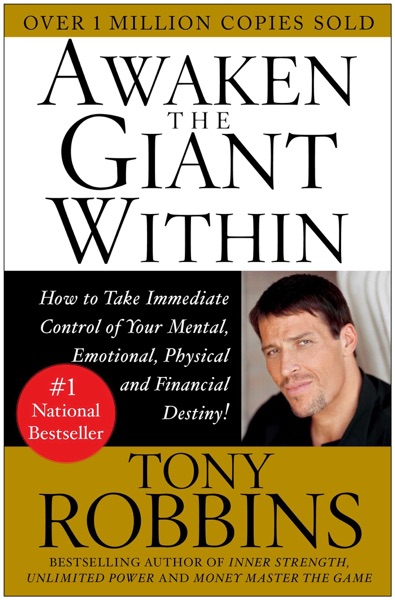
Talk to Awaken the Giant Within like its author wrote you back.
Get the ideas that fit your life — not generic summaries.
- Chat with the book
- Audiobook-style main ideas
- Adapts to your life and goals
- Helps you take action
Awaken the Giant Within, in detail
Awaken the Giant Within is Tony Robbins' comprehensive manual for personal transformation, built on the premise that most people operate at a fraction of their potential because they have never taken control of the forces that shape their behavior: their beliefs, values, emotions, and the questions they habitually ask themselves. Robbins argues that destiny is not a matter of chance but of decisions, and that most decisions go unmade not from lack of opportunity but from lack of a clear process for making them.
The first major section covers the mechanics of belief. Robbins draws a distinction between global beliefs — sweeping convictions about the world, other people, and oneself — and rules, the specific conditions people set for whether a belief is being met. He contends that most suffering comes not from life itself but from having rules that are nearly impossible to satisfy: "I'll feel respected when..." followed by conditions no one around you can consistently meet. Changing those rules, Robbins argues, changes the emotional experience of an unchanged life almost instantly.
The book's treatment of values is more unusual. Robbins distinguishes between moving-toward values (what you seek: love, adventure, security) and moving-away-from values (what you avoid: rejection, failure, embarrassment). He claims that most people are more powerfully motivated by what they're running from than by what they're running toward, and that understanding your own hierarchy explains chronic patterns of behavior that no amount of willpower has been able to shift.
The final sections cover goal-setting, the management of states — the physiological and emotional conditions that govern performance — and a life planning exercise called the Dickens Process. Robbins is more a synthesizer than an originator; many ideas here appear in other forms elsewhere. The book is also long, repetitive in places, and written in a relentless high-energy register that some readers find motivating and others find exhausting. Its value is proportional to how seriously a reader takes the worksheets and exercises, which are embedded throughout rather than confined to an appendix.
The big ideas
- 1.
Decisions shape destiny more than conditions. The moments when you decide to act, change, or commit have more long-term impact than most events that happen to you.
- 2.
Your beliefs create your reality. A belief is simply a feeling of certainty about what something means, and beliefs can be installed or dismantled deliberately.
- 3.
Pain and pleasure are the twin forces behind all behavior. Understanding which one is currently driving a pattern is the first step to changing it.
