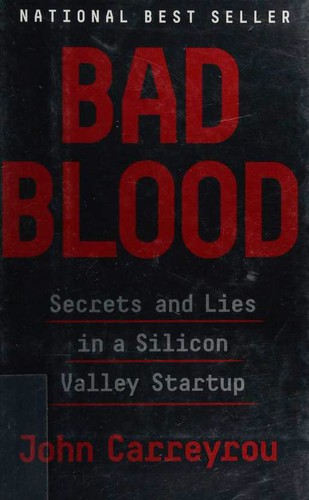
Talk to Bad Blood: Secrets and Lies in a Silicon Valley Startup like its author wrote you back.
Get the ideas that fit your life — not generic summaries.
- Chat with the book
- Audiobook-style main ideas
- Adapts to your life and goals
- Helps you take action
What it argues
Bad Blood is Wall Street Journal reporter John Carreyrou's account of Theranos, the blood-testing startup founded by Elizabeth Holmes that claimed its proprietary technology could run hundreds of diagnostic tests from a single finger-prick of blood. From its founding in 2003 through its collapse in 2018, Theranos raised nearly $900 million, reached a peak valuation of $9 billion, and made Holmes the youngest female self-made billionaire in America — all built on technology that didn't work and results that put patients at risk.
Carreyrou reconstructs the fraud through interviews with dozens of former employees, many of whom faced legal threats and nondisclosure agreements that kept them silent for years. The picture that emerges is of a culture built on fear, secrecy, and a founder's absolute unwillingness to hear that the science wasn't there. Holmes modeled herself on Steve Jobs — the black turtleneck, the reality-distortion field, the refusal to accept engineering limits as real limits. Her partner Ramesh "Sunny" Balwani enforced that culture through intimidation. Employees who raised concerns were fired or threatened; those who stayed learned to look away. The board, stacked with political luminaries rather than scientists or medical professionals, provided almost no meaningful oversight.
What it gets right
- 1.
Theranos raised $900 million and reached a $9 billion valuation on technology that never worked as claimed. The core blood-testing device produced results too unreliable for clinical use.
- 2.
Holmes deliberately modeled herself on Steve Jobs, adopting his aesthetic and his confrontational management style. The imitation extended to suppressing bad news and firing engineers who said the technology had limits.
- 3.
The board was stacked with political heavyweights — Kissinger, Shultz, Mattis — who brought prestige and no ability to evaluate the science. Domain expertise matters on boards where the product is technical.
What it covers
Who wrote it
John Carreyrou is an investigative reporter at the Wall Street Journal, where he won two Pulitzer Prizes — one in 2015 for his Theranos reporting and one earlier for coverage of Medicare fraud. Bad Blood, published in 2018, grew out of that investigation and became an instant bestseller. Carreyrou spent years building sources inside Theranos under legal threat from Holmes's attorneys. He is also the author of Hot Seat, a follow-up examining the trial. Before the Journal he covered health and science at The Philadelphia Inquirer.
