Bad Blood: Secrets and Lies in a Silicon Valley Startup by John Carreyrou is a 2018 business book about corporate fraud, silicon valley culture, investigative journalism. Theranos raised $900 million and reached a $9 billion valuation on technology that never worked as claimed. The core blood-testing device produced results too unreliable for clinical use.
Summary
Bad Blood is Wall Street Journal reporter John Carreyrou's account of Theranos, the blood-testing startup founded by Elizabeth Holmes that claimed its proprietary technology could run hundreds of diagnostic tests from a single finger-prick of blood. From its founding in 2003 through its collapse in 2018, Theranos raised nearly $900 million, reached a peak valuation of $9 billion, and made Holmes the youngest female self-made billionaire in America — all built on technology that didn't work and results that put patients at risk.
Carreyrou reconstructs the fraud through interviews with dozens of former employees, many of whom faced legal threats and nondisclosure agreements that kept them silent for years. The picture that emerges is of a culture built on fear, secrecy, and a founder's absolute unwillingness to hear that the science wasn't there. Holmes modeled herself on Steve Jobs — the black turtleneck, the reality-distortion field, the refusal to accept engineering limits as real limits. Her partner Ramesh "Sunny" Balwani enforced that culture through intimidation. Employees who raised concerns were fired or threatened; those who stayed learned to look away. The board, stacked with political luminaries rather than scientists or medical professionals, provided almost no meaningful oversight.
What makes Carreyrou's reporting land is the human cost. Theranos ran its unvalidated tests on real patients in Walgreens stores in Arizona and California. People received false positives for cancer, false negatives for HIV, abnormal results that sent them to doctors with imaginary problems. The company's internal Edison machines were so unreliable that Theranos secretly ran most samples on commercial Siemens analyzers — while telling patients the results came from proprietary technology. The fraud wasn't a victimless financial crime; it was a medical one.
The book is also a case study in how Silicon Valley's "fake it till you make it" ethos, its deference to charismatic founders, and its structural distrust of skeptics made the fraud possible for as long as it was. Sophisticated investors skipped due diligence because Holmes was compelling and the story was good. Journalists wrote hagiographies. The legal apparatus Holmes deployed against whistleblowers worked. Carreyrou's own investigation required years of source-building and legal battles before the story ran. Bad Blood is a warning about what happens when the mechanisms designed to catch fraud — boards, auditors, regulators, the press — are all neutralized at once.
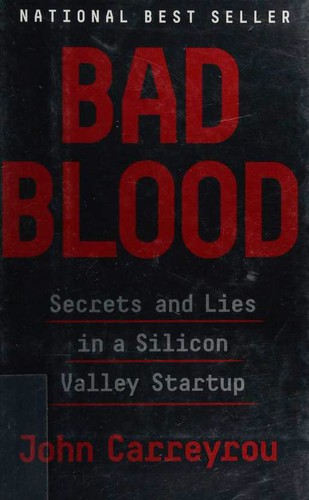
Talk to Bad Blood: Secrets and Lies in a Silicon Valley Startup like its author wrote you back.
Get the ideas that fit your life — not generic summaries.
- Chat with the book
- Audiobook-style main ideas
- Adapts to your life and goals
- Helps you take action
Key takeaways
- 1.
Theranos raised $900 million and reached a $9 billion valuation on technology that never worked as claimed. The core blood-testing device produced results too unreliable for clinical use.
- 2.
Holmes deliberately modeled herself on Steve Jobs, adopting his aesthetic and his confrontational management style. The imitation extended to suppressing bad news and firing engineers who said the technology had limits.
- 3.
The board was stacked with political heavyweights — Kissinger, Shultz, Mattis — who brought prestige and no ability to evaluate the science. Domain expertise matters on boards where the product is technical.
- 4.
Theranos deployed aggressive nondisclosure agreements and legal threats against employees who raised concerns. The legal intimidation worked for years and kept the fraud hidden from the press.
- 5.
Most Theranos blood tests were secretly run on commercial Siemens machines, not the proprietary Edison device. Patients and doctors were deceived about the source of their results.
- 6.
Real patients received false positives and false negatives from unvalidated tests. The fraud caused concrete medical harm, not just financial loss to investors.
- 7.
Silicon Valley's culture of charismatic founders and 'move fast' skepticism of regulators created the conditions for the fraud. Investors repeatedly skipped scientific due diligence because the story was too good to scrutinize.
- 8.
Carreyrou's investigation required years of building sources inside a heavily litigated company. Whistleblowers risked lawsuits and career destruction to talk. The story ran in 2015; Holmes was convicted in 2022.
Discussion questions
Use these on your own, with a book club, or as chat starters in Superbook. Book club version, ready to copy or print →
- 1.
Holmes told investors and the press what they wanted to hear for years. What features of Silicon Valley culture made that easier — and what made it harder to stop?
- 2.
The board included secretaries of state and a former defense secretary but no practicing physicians or clinical lab scientists. How should boards be composed when a company's core claim is technical?
- 3.
Several employees raised internal concerns and were fired or threatened. At what point does loyalty to a company stop being a virtue, and what would you have done in their position?
- 4.
Theranos's investors repeatedly skipped scientific due diligence because Holmes was compelling and the pitch was good. What does this suggest about how charisma functions in high-stakes decisions?
- 5.
Carreyrou describes a culture where employees learned not to share information across teams. Have you worked in an organization where internal secrecy made it hard to see problems clearly?
- 6.
Holmes argued, even after conviction, that she genuinely believed the technology would work. How much does intent matter when the harm to patients was real and documented?
- 7.
The phrase 'fake it till you make it' is widely accepted in startup culture. Where is the line between optimistic projection and fraud, and who gets to draw it?
- 8.
Tyler Shultz blew the whistle despite direct pressure from his grandfather, who was on the Theranos board. What does it take for someone to report wrongdoing when the personal costs are that high?
- 9.
Theranos targeted underserved patients who couldn't easily access traditional labs. The pitch was democratizing healthcare. How did a nominally progressive mission get used to deflect scrutiny?
- 10.
Journalists published glowing profiles of Holmes for years before Carreyrou's investigation. What should a reporter ask when a founder refuses to let experts examine the product?
- 11.
Balwani ran day-to-day operations through fear and public humiliation. What organizational conditions allow that kind of management style to persist unchallenged?
- 12.
Bad Blood ends with Holmes's fraud exposed but the structural conditions that enabled it largely unchanged. What would actually have to change in how we fund, regulate, and cover startups for this to be less likely?
Themes
Frequently asked questions
-
Is Bad Blood worth reading?
Yes. It reads like a thriller and is thoroughly reported. Even if you know the Theranos story from the documentary or podcast, Carreyrou's account is more detailed and gives weight to the patients who were harmed. The strongest parts are the employee narratives, which show how the fraud was maintained day to day.
-
How long does it take to read Bad Blood?
Around six hours at average reading pace for the 340-page book. The chapters are structured around individual characters, which makes it easy to read in sittings of two or three chapters at a time.
-
What is Bad Blood about?
It is the story of Theranos, the blood-testing startup founded by Elizabeth Holmes, and the decade-long fraud that kept investors and patients from knowing its technology didn't work. Carreyrou traces the fraud from founding through collapse through interviews with former employees, many of whom spoke at personal and legal risk.
-
Who should read Bad Blood?
Anyone interested in startup culture, corporate governance, investigative journalism, or healthcare regulation. It is also essential reading for anyone who sits on a board, invests in early-stage companies, or works inside a culture where bad news doesn't travel upward.
-
What's the most important lesson from Bad Blood?
That the mechanisms designed to catch fraud — independent boards, due diligence, regulators, the press — can all be neutralized simultaneously when a charismatic founder controls information, deploys legal threat aggressively, and benefits from an environment that rewards optimism over scrutiny. Each failure was individually explainable; together they were catastrophic.
Similar books
The Big Short: Inside the Doomsday Machine
Michael Lewis
Empire of Pain: The Secret History of the Sackler Dynasty
Patrick Radden Keefe
Shoe Dog: A Memoir by the Creator of Nike
Phil Knight
Zero to One: Notes on Startups, or How to Build the Future
Peter Thiel
